 Get in touch
 English
 Deutsch
 中文简体
中文简体 Español

1. Introduction: Deconstructing AC Induction Motor Horsepower The AC Induction Motor is one of the m...
READ MOREIndustry News
2026-10-01
Content
A 130 mm brushless motor driving a 2 kW industrial blower pulls roughly 6 A per phase on a rectified 230 VAC bus, and the part that fails first in the field is rarely the copper. Bearings, the thermal path, or a drive that cannot deliver starting current reach their limit before the winding does. That is the practical reality of a huge brushless motor: above roughly 1 kW it stops being a catalog line item and becomes a system decision covering winding, cooling, sensing and harness.
A huge brushless motor is a three-phase permanent-magnet machine with a stator outer diameter of 100 mm or more, a continuous output above roughly 500 W, and a shaft torque measured in whole newton-metres instead of fractions.
Frame diameter is the first filter because torque scales with rotor diameter squared and with stack length linearly at a fixed magnetic shear stress. Moving from a 57 mm to a 112 mm frame at the same stack length is close to a fourfold torque gain, before magnet grade, winding or cooling enters the picture. That one relationship explains why 57 mm motors are bought from stock by the thousand while 100 mm and 130 mm units are almost always built to a drawing.
Working definition: a huge brushless motor is any radial-flux BLDC with a stator outer diameter of 100 mm or greater, a continuous rating at or above 500 W, and rotor inertia high enough that the drive must be selected as part of the motor specification rather than after it.
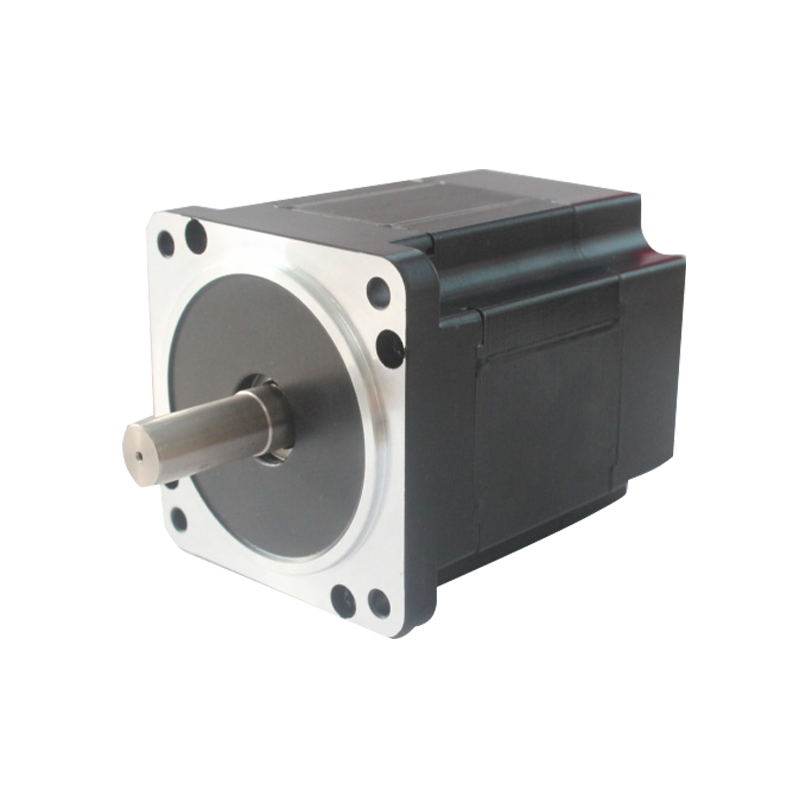
Retek Motion builds this class in 100 mm, 112 mm and 130 mm frames, including a 130 mm heavy-duty blower motor rated 2 kW on 230 VAC and a 112 mm low-cogging unit rated 600 W at 24 VDC. The wider range is collected under high-power brushless DC motors.
Sizing comes down to four numbers: continuous torque, duty cycle, DC bus voltage, and thermal resistance from winding to ambient. Fix those four and frame diameter, stack length and winding nearly choose themselves.
Continuous torque is a thermal number. A 130 mm frame that peaks at 12 Nm on a bench often holds 4 to 5 Nm in still air, because the copper loss that produced the peak has nowhere to go once the winding reaches its insulation limit.
Copper loss rises with the square of current, so a 20 percent overload adds about 44 percent more heat. Two levers matter more than anything else at this size: the cooling path and the sealing class. Forced air across a finned housing typically buys 1.5 to 2 times the continuous torque of the same frame in still air. A washdown-rated IP65 housing adds a thermal barrier between winding and airflow, which is why a sealed motor of identical dimensions usually carries a lower continuous rating than its open counterpart.
Industrial air movement tests that argument hardest, because a 2 kW continuous machine has to shed roughly 300 W of loss from a housing that is often sealed against dust.
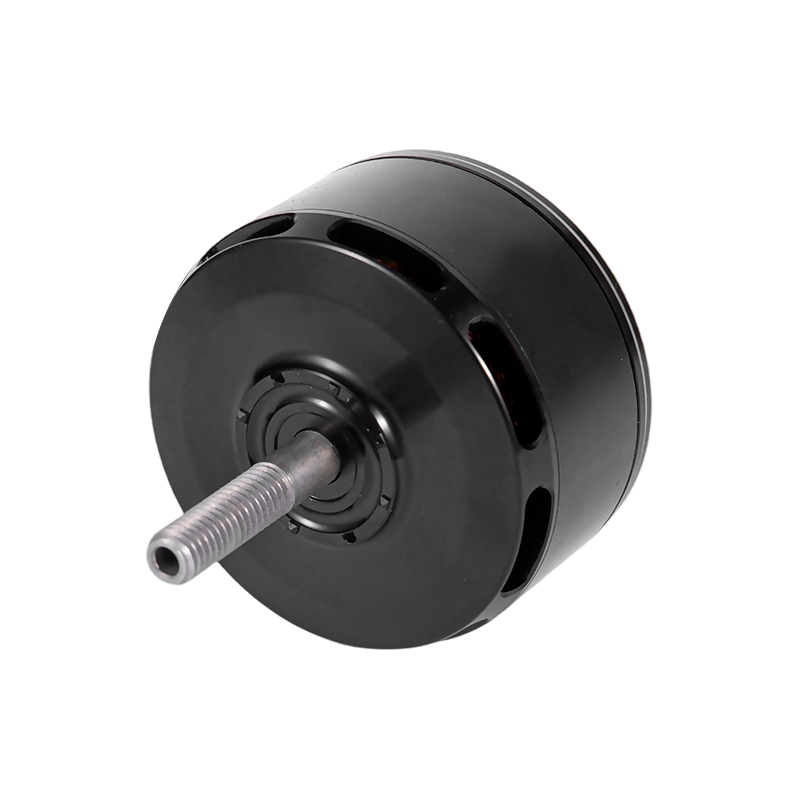
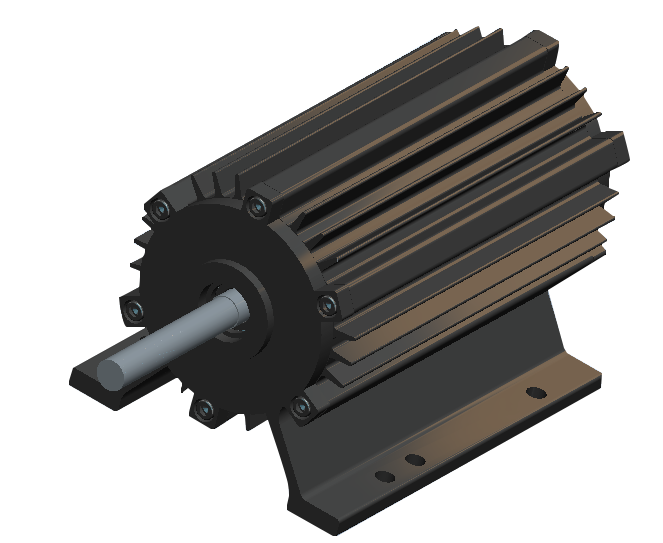 BL130 130mm 230VAC 2kW Industrial Heavy-Duty Blower MotorFor industrial air movement, this 130 mm 2 kW blower motor targets high-airflow, sealed high-load duty with efficient, low-noise, customizable OEM/ODM construction.View Product →
The most common field failure of a huge brushless motor is not a burnt winding, but a drive that cannot supply current at the instant the rotor asks for it.
Peak torque needs peak current, and the inverter must sustain that current without exceeding its own junction temperature. A 2 kW motor on a 310 V bus draws about 6 to 7 A at rated load, comfortably inside a modest drive; the same shaft power on a 24 V bus needs 85 to 90 A, which changes cable cross-section, connector rating and the thermal design of the MOSFET stage. Torque constant and bus voltage are therefore one decision, not two.
Starting behavior splits sensorless from sensored drives. A sensored motor with Hall sensors or an encoder holds full torque from zero speed. Sensorless control loses rotor position confidence below roughly 5 to 10 percent of rated speed, which is exactly where a loaded conveyor or a geared joint starts.
| Bus class | Typical frame | Continuous power | Drive consideration |
| 24 VDC | 76 to 112 mm | 300 to 600 W | High current, short cable runs, heat sink area dominates drive size |
| 48 VDC | 86 to 130 mm | 600 W to 3 kW | Best compromise for battery platforms, 12 to 60 A per phase |
| 310 VDC rectified mains | 100 to 130 mm | 1 to 3.5 kW | Low current, sensorless start limits, regeneration handling needed |
| 22.2 to 90 V battery | 60 to 100 mm stator | 1 to 5 kW peak | ESC timing, propeller matching, short duty cycles |
On a 24 V bus, traction-class hardware stays in the few-hundred-watt class, which suits sealed material handling equipment that has to start under load.
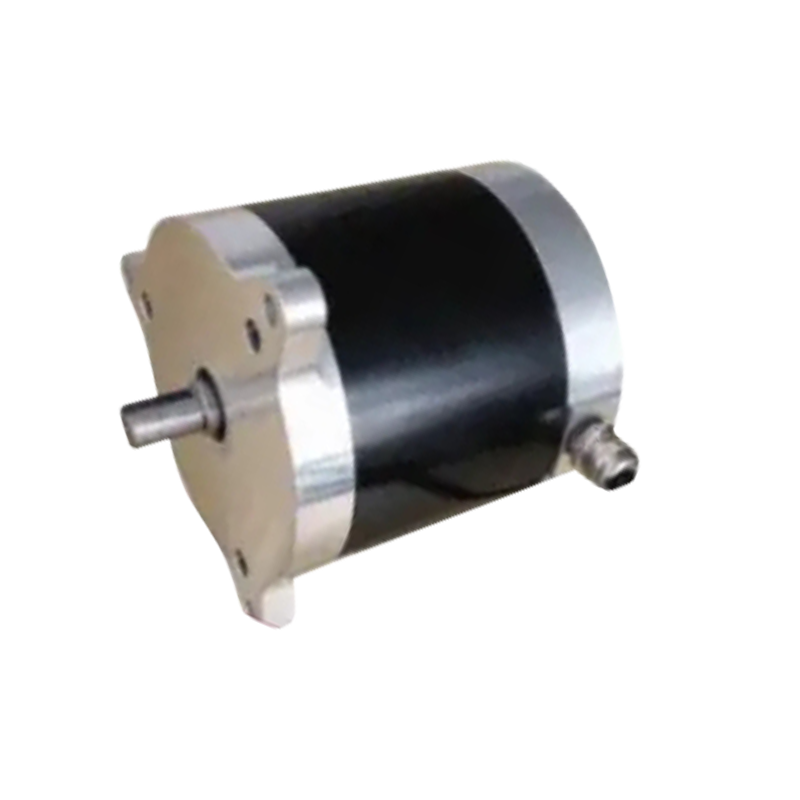 BL100 100mm 24VDC 300W Electric Forklift MotorFor 24 V material handling, this 100 mm 300 W motor supports forklifts and pallet trucks with stable output, low noise, and long service life.View Product →
Above roughly a few hundred units a year, a custom-wound large brushless motor usually beats a catalog unit that almost fits, because every compromise in gearing, mounting or cabling is paid again on every unit shipped.
The economics only work when the parts are made in one place. Jiangsu Retek Motion Co., Ltd. moved die casting, CNC machining and cable injection in-house between 2021 and 2023, which is what makes a matched housing and harness practical at low volume; by 2024 the company was shipping into more than 20 countries. Custom builds start from an RFQ carrying the four sizing numbers, not from a catalog figure.
Large brushless motors concentrate in five application families: traction and material handling, industrial air movement, heavy-lift unmanned aircraft, geared robotic joints, and medical or personal-care tools.
| Application | Typical frame | Typical rating | Deciding constraint |
| Forklift and AGV traction | 100 to 112 mm | 300 to 600 W continuous | Sealed housing, high starting torque, 24 to 48 V bus |
| Industrial blower and axial fan | 130 mm | 2 kW continuous | Continuous duty, bearing life, constant airflow control |
| Heavy-lift UAV | 87 to 137 mm stator | 1 to 5 kg thrust per rotor | Thrust-to-weight, ESC timing, 6S to 24S packs |
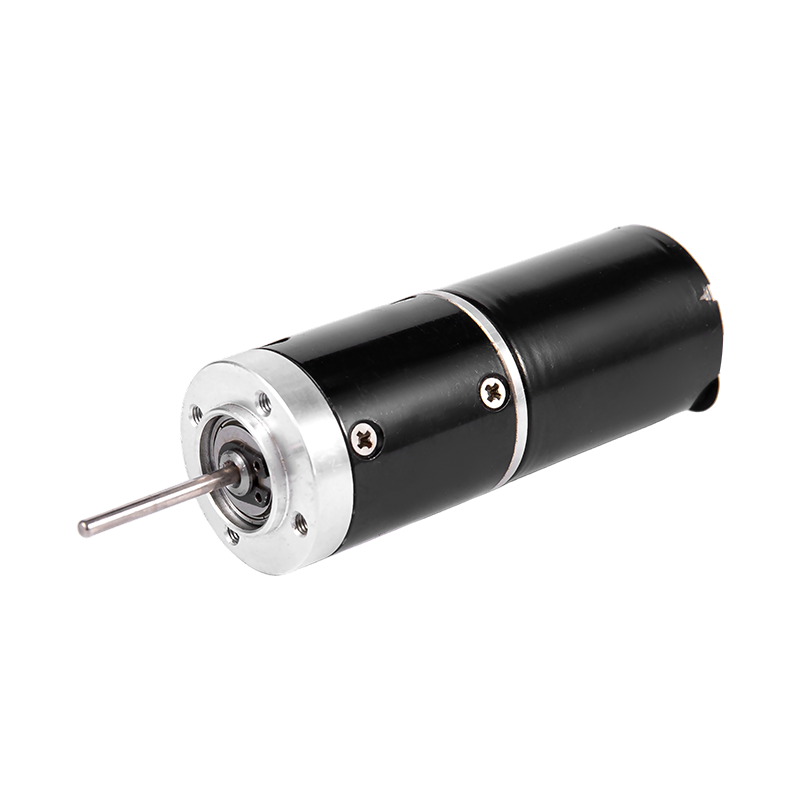
| Robotic joint with gearhead | 40 to 64 mm plus gearbox | 60 to 200 Nm at the output | Backlash, encoder resolution, harmonic gearing |
| Medical drill and personal care | 22 to 42 mm | 100 to 500 W peak | Noise, cleanability, compact servo control |
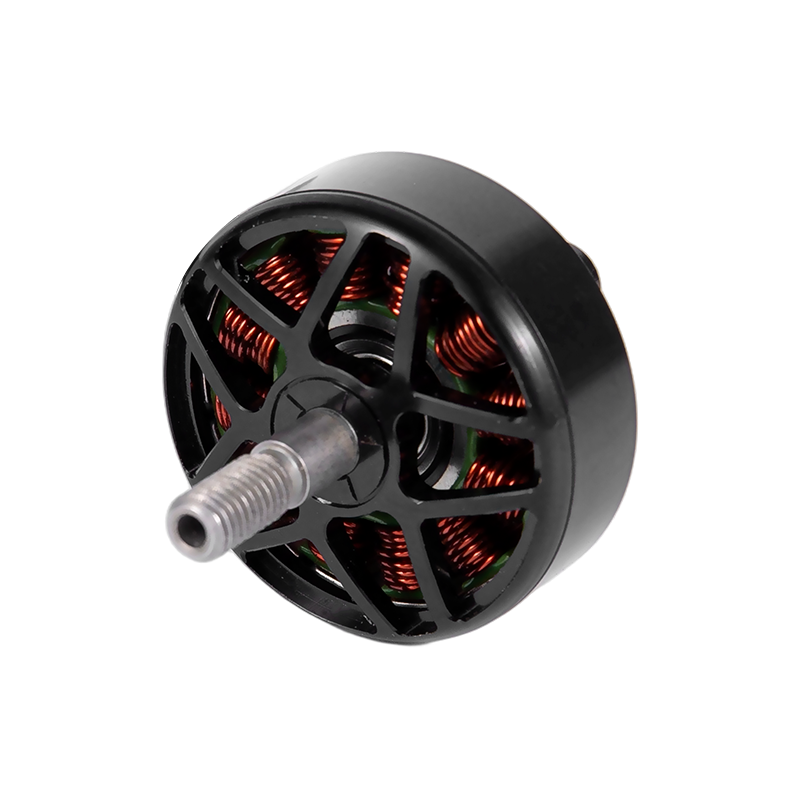
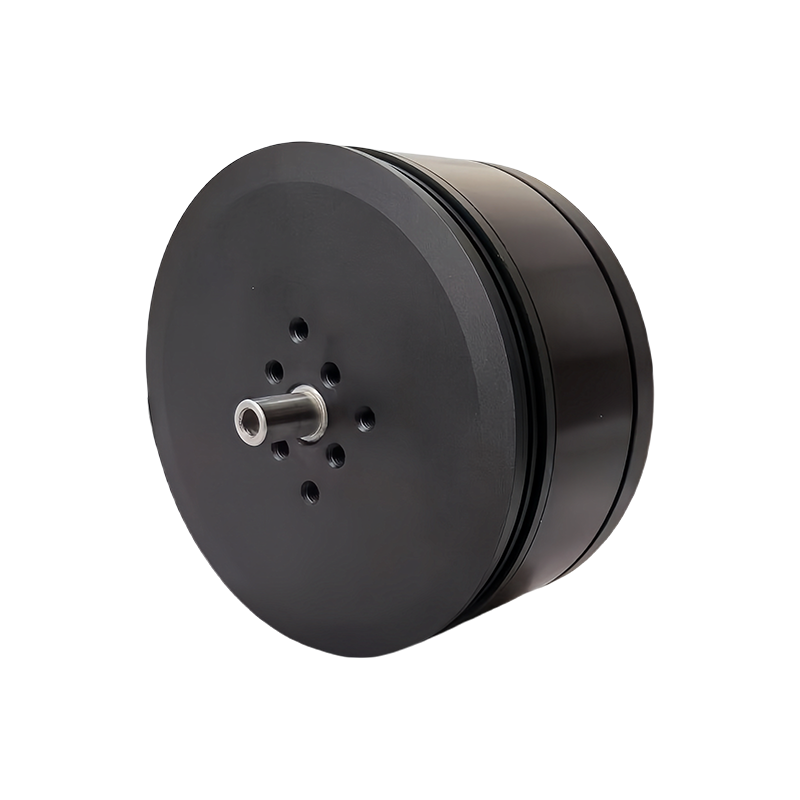 LN13720 24S Brushless Drone Motor for Heavy-Lift UAVsA 24S heavy-lift UAV motor offered in 34KV and 38KV, aimed at cargo drones and professional aerial platforms needing torque, efficiency, and heat dissipation.View Product →
A 130 mm frame typically delivers 10 to 15 Nm of peak torque and 4 to 6 Nm continuously with a class F winding in still air. The spread comes from stack length, magnet grade and cooling: the same stator that holds 5 Nm in free air can hold 8 to 10 Nm with forced convection and class H insulation.
Yes, by roughly 8 to 15 percentage points at the same output, because there is no brush and commutator drop. A 104 mm brushed motor rated 180 VDC and 1000 W remains competitive on purchase price and is simple to drive, but brush wear sets the maintenance interval and the commutator limits continuous current in sealed or high-altitude installations.
Send five inputs: continuous and peak torque with duration, duty cycle, DC bus voltage, ambient temperature with cooling method, and the mechanical interface including shaft, flange and connector. Frame diameter, stack length and winding all follow from those five; without them, any quoted torque constant is a guess.
Rule of thumb: if two motors share a frame size and differ in continuous rating by more than 30 percent, the difference is almost always in the cooling path or the insulation class, not in the magnets.
1. Introduction: Deconstructing AC Induction Motor Horsepower The AC Induction Motor is one of the m...
READ MORE1. Introduction In modern industrial automation, data center construction, consumer electronics upgr...
READ MOREStepper motors represent a cornerstone of modern motion control, offering precise positioning and re...
READ MOREThe industrial motor landscape is undergoing a significant transformation, driven by the relentless ...
READ MORERelated Products
Building 10, No.199, Jinfeng Road, Suzhou High-tech, Jiangsu Province, China
+86-133 3869 4967
+86-512 6876 9967
sean@retekmotion.com
rsgrivic@126.com
 WhatsApp
Copyright © Jiangsu Retek Motion Co., Ltd. All Rights Reserved. Custom OEM Industrial Multi Rotor Drone Motors Manufacturers