 Get in touch
 English
 Deutsch
 中文简体
中文简体 Español

1. Introduction: Deconstructing AC Induction Motor Horsepower The AC Induction Motor is one of the m...
READ MOREIndustry News
2026-10-16
Content
A 2 kW industrial blower retrofitted with a 57 mm brushless motor rarely fails at the drive. It fails at the winding, which reaches 130 degrees Celsius inside the first 40 minutes of continuous duty. Frame diameter, not controller tuning, decides whether a large brushless motor survives that cycle, and it is the first number Jiangsu Retek Motion Co., Ltd. checks when an OEM sends an RFQ.
Retek Motion, based in Suzhou, China, brought brushless DC motor manufacturing in-house in 2018, added cable injection and CNC machining in 2021, and served customers in more than 20 countries by 2024. That history explains the priority order: on motors above the 80 mm frame line, the mechanical and thermal decisions are settled long before the electronics are.
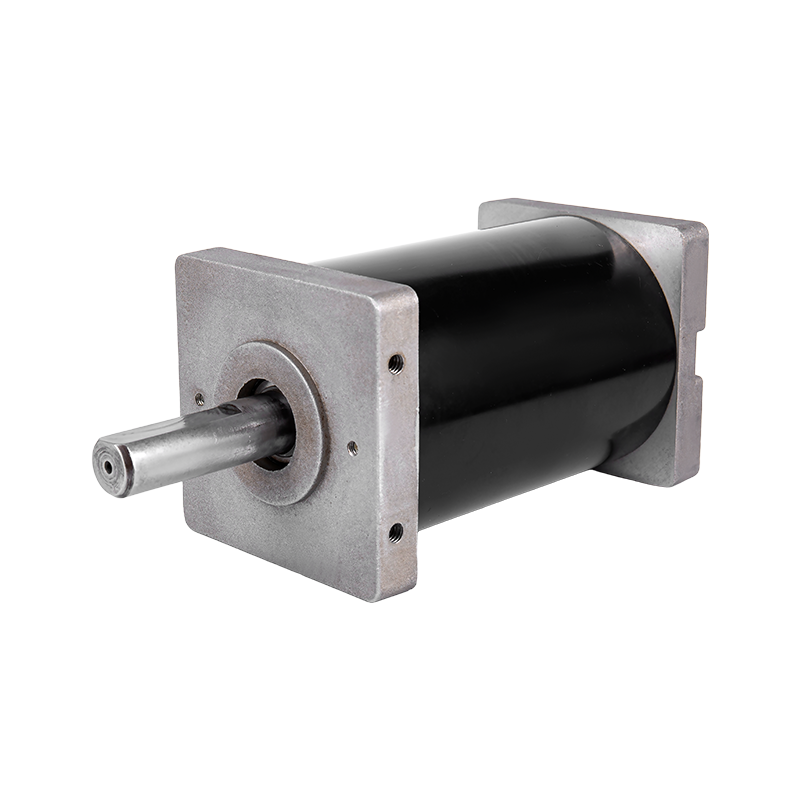
A large brushless motor is a three-phase permanent-magnet synchronous motor with a stator outer diameter of 80 mm or more, rated for roughly 0.3 kW to 3 kW of continuous shaft power and normally specified on a 24 V to 400 V bus.
The boundary is thermal rather than cosmetic. A 600 W continuous motor rejects roughly 45 to 70 W as heat. Housing surface area grows with the square of diameter, while the losses the housing must carry grow with volume, so below 60 mm most designs can rely on convection and radiation alone. Above 80 mm that stops working, which is why the same 24 V bus that spins a 42 mm motor quietly will cook an 86 mm stator unless the current is brought down by a higher turn count or a higher supply voltage.
| Frame (stator OD) | Continuous shaft power | Usual bus voltage | Cooling | Typical duty |
| 57 mm | 150 to 350 W | 24 to 48 V | Natural convection | Fans, pumps, light positioning |
| 80 mm | 300 to 600 W | 24 to 48 V | Heatsink, convection | Washdown fans, medical, AGV |
| 86 mm | 350 to 750 W | 310 V | Forced air | Blowers, spindle support |
| 100 mm | 0.6 to 1.0 kW | 24 to 72 V | Forced air | Traction, forklift drives |
| 112 mm | 1.0 to 1.4 kW | 24 to 72 V | Forced air | Robotics, pumps, transmission |
| 130 mm | 1.5 to 2.0 kW and above | 230 V AC input | Forced air or liquid | Industrial blowers, axial fans |
Large brushless motors pay for themselves in five duty cycles: continuous air movement, traction and steering, pump and compressor drives, low-cogging positioning, and heavy robotic joints.
Continuous air movement is the easiest case to justify on energy alone. An industrial axial fan running 8,000 hours a year at 2 kW draws 16,000 kWh; every percentage point of efficiency recovered is worth more than any saving available in the control cabinet. Large brushless frames win here because slot fill, magnet grade and bearing drag are all easier to optimize once the stator has enough room for copper.
Traction and steering reward the topology differently. A forklift drive needs full torque at zero speed, which a brushed motor only delivers by wearing its commutator and brushes. A 24 V DC, 300 W brushless traction unit holds peak torque without contact wear, and steering systems above 1 kW usually need the same behavior in a smaller envelope. Where a project crosses that 1 kW threshold, platform ranges such as high power brushless DC motors are worth reviewing before the frame is fixed, because the voltage class chosen at this stage limits everything downstream.
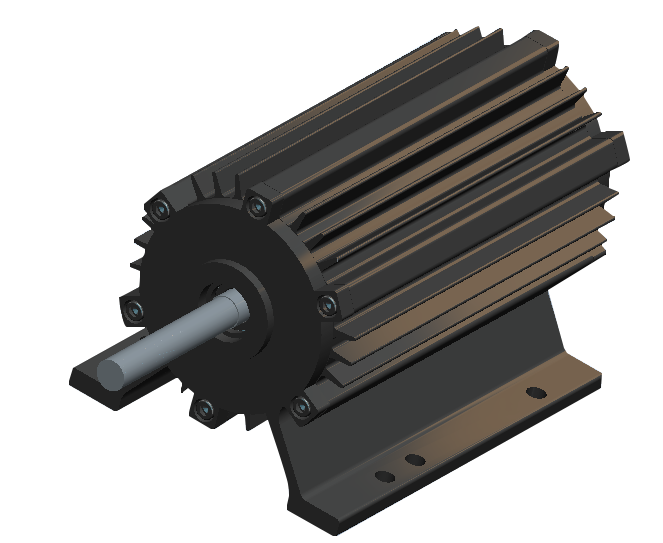 BL130 130 mm Industrial Heavy-Duty Blower Motor 230 VAC 2 kWA 130 mm, 230 VAC, 2 kW blower motor for heavy-duty airflow; review when high-power, high-load blower duty and industrial durability drive selection.View Product →
Five variables decide whether a large brushless motor meets its rating: winding temperature margin, bus voltage and turns count, cogging torque, bearing and shaft loading, and where the controller physically lives.
Continuous ratings are set by the hottest spot, not the average. A winding sitting at 130 degrees Celsius behind Class F insulation rated to 155 degrees keeps 25 degrees of thermal margin. Magnet strength falls with heat as well, at roughly 0.11 percent of remanence per degree above 20 degrees Celsius, so ten extra degrees of running temperature costs about one percent of available torque before any electrical effect shows up in the data sheet.
Current is the expensive part of a large brushless motor. A 2 kW motor on a 24 V bus draws close to 90 A, which forces thick magnet wire, a large controller and a short thermal path. Running the same output from a 230 V AC input drops current below 10 A and shrinks resistive loss dramatically, because loss tracks the square of current. Raising voltage is usually the cheapest way to make a large frame run cooler.
Cogging torque is what an operator feels when turning the shaft by hand, and what a positioning loop fights at low speed. In large frames, slot-and-pole combinations plus rotor skew decide whether cogging stays under two percent of rated torque or climbs past five percent. Low-cogging frames matter most in medical drills, personal-care products and robotic joints, where torque ripple turns directly into noise and surface finish.
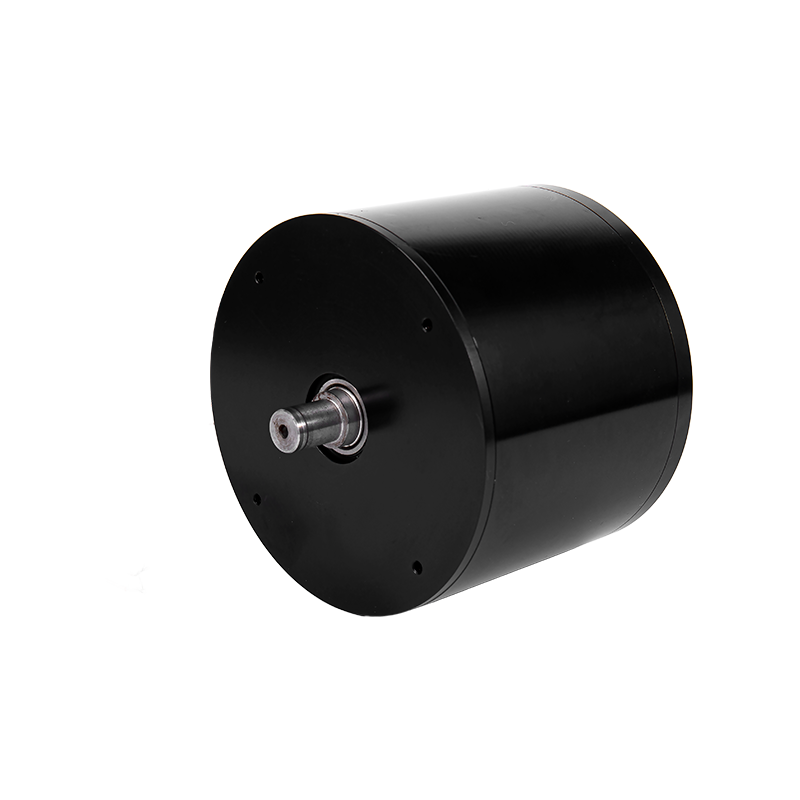 BL112 112 mm Low-Cogging Brushless DC Motor 24 VDC 600 WA 112 mm, 24 VDC, 600 W brushless motor with low cogging for smooth, precise operation; worth review where vibration and torque ripple affect positioning.View Product →
Frame size brings rotor mass and bearing load with it. A 130 mm motor driven by a belt and pulley can add several hundred newtons of side load at the shaft end, and a bearing pair sized for a 57 mm frame will not reach its rated L10 life under that load. Ask for the radial and axial load limits in newtons, then compare them with the actual belt tension or gear reaction.
Where the drive lives decides cable length, enclosure size and service access. An integrated controller removes one to three metres of motor cable, which cuts switching loss and radiated noise, and lets a single sealed unit meet an IP65 washdown requirement without a separate cabinet. A platform such as the IP65-rated washdown brushless motor class shows how that packaging choice is made at the 80 mm frame line.
Continuous power scales faster than frame diameter, so moving up one frame size buys far more than a proportional gain in output.
Above the 100 mm frame line, custom motors usually beat catalogue stock on total project cost, because the winding, shaft and connector define the project more than the lamination stack does.
The trade-off is real, and it is not always about price. A 100 mm class traction motor built for a specific forklift envelope can eliminate a coupling, a shim stack and an adapter plate, and each removed interface is one fewer tolerance stack to control. The catalogue route wins when quantities are low, the machine already has a proven motor mount, and downtime is the dominant cost.
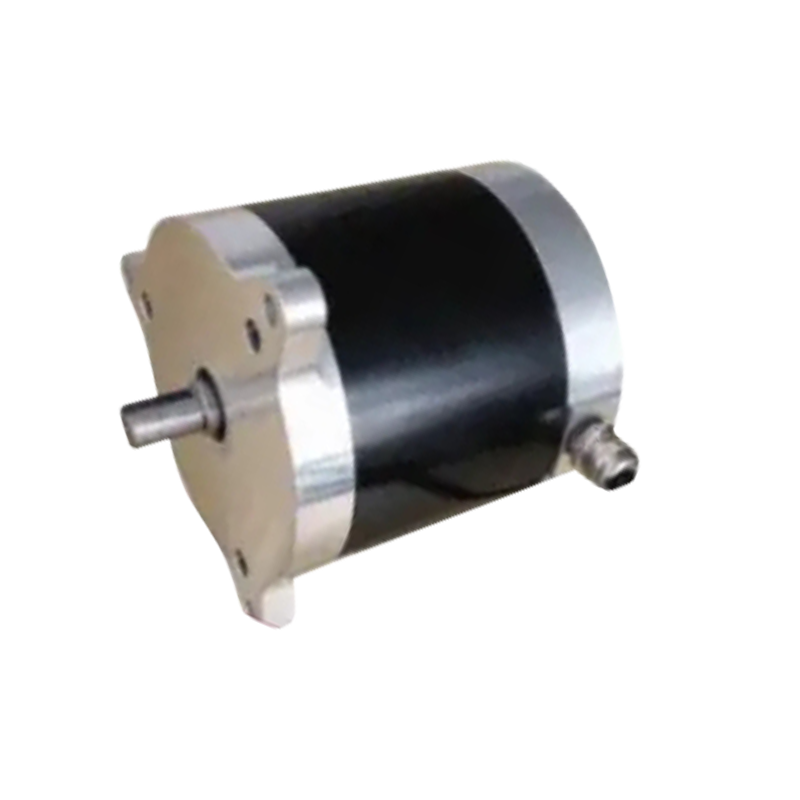 BL100 100 mm Electric Forklift Motor 24 VDC 300 WA 100 mm, 24 VDC, 300 W brushless motor for forklifts and pallet trucks; review for stable material-handling power and long service life.View Product →
Six numbers decide the quotation. Send them together and a motor manufacturer can quote a frame and winding the first time instead of the third.
Eighty millimetres of stator outer diameter is the practical threshold. Above it, continuous ratings move past 300 W, forced cooling becomes necessary, and bearing, shaft and winding choices start to dominate the design.
A forced-air-cooled 130 mm frame typically holds 1.5 to 2 kW continuously, with a 230 V AC input keeping current low enough that a sealed housing can still be used. Liquid cooling pushes the same frame higher.
Not necessarily. Integrated controllers remove one to three metres of motor cable and simplify IP65 packaging, which matters in washdown and outdoor equipment. Separate drives win when the cabinet already exists and serviceability is the priority.
Choose a slot and pole combination with a high least common multiple, add rotor or stator skew, and keep the air gap consistent through a machined housing. These three changes routinely hold cogging below two percent of rated torque.
1. Introduction: Deconstructing AC Induction Motor Horsepower The AC Induction Motor is one of the m...
READ MORE1. Introduction In modern industrial automation, data center construction, consumer electronics upgr...
READ MOREStepper motors represent a cornerstone of modern motion control, offering precise positioning and re...
READ MOREThe industrial motor landscape is undergoing a significant transformation, driven by the relentless ...
READ MORERelated Products
Building 10, No.199, Jinfeng Road, Suzhou High-tech, Jiangsu Province, China
+86-133 3869 4967
+86-512 6876 9967
sean@retekmotion.com
rsgrivic@126.com
 WhatsApp
Copyright © Jiangsu Retek Motion Co., Ltd. All Rights Reserved. Custom OEM Industrial Multi Rotor Drone Motors Manufacturers