 Get in touch
 English
 Deutsch
 中文简体
中文简体 Español

1. Introduction: Deconstructing AC Induction Motor Horsepower The AC Induction Motor is one of the m...
READ MOREIndustry News
2026-06-02
Content
A DC motor converts direct current electrical energy into mechanical rotation through the interaction of magnetic fields. Understanding how a DC motor works on the principle of Lorentz force is the first step, but selecting the right variable speed 12V DC motor and wiring it correctly—especially a 4 wire DC motor connection diagram—determines real-world performance. This article unpacks the components of a DC motor, shows exact wiring diagram for DC motor setups, and explains speed and torque control of DC motor systems with practical data. We also contrast how does an AC motor work so you can make a clear choice.
A DC motor works on the principle of the Lorentz force law: when a current-carrying conductor is placed in a magnetic field, it experiences a mechanical force. Inside every brushed DC motor, this force acts on the armature windings, creating torque that spins the shaft. The direction of rotation is determined by Fleming’s left-hand rule—if the current or magnetic field polarity is reversed, the motor reverses direction. In a permanent magnet DC motor, the stator provides a fixed field, and the armature current directly controls torque; the relationship is linear, with torque in Nm being the product of the motor’s torque constant (Kt) and armature current. In a typical variable speed 12V DC motor, Kt might be around 0.05 Nm/A, meaning 2 A produces roughly 0.1 Nm of continuous torque.
Another critical principle is back electromotive force (back EMF). As the armature spins, it generates a voltage opposing the supply. The speed of the motor stabilizes when the back EMF plus the resistive voltage drop equals the applied voltage. This self-regulating behavior allows speed and torque control of DC motor circuits to be highly predictable: reduce voltage, and the motor slows down until a new equilibrium is reached.
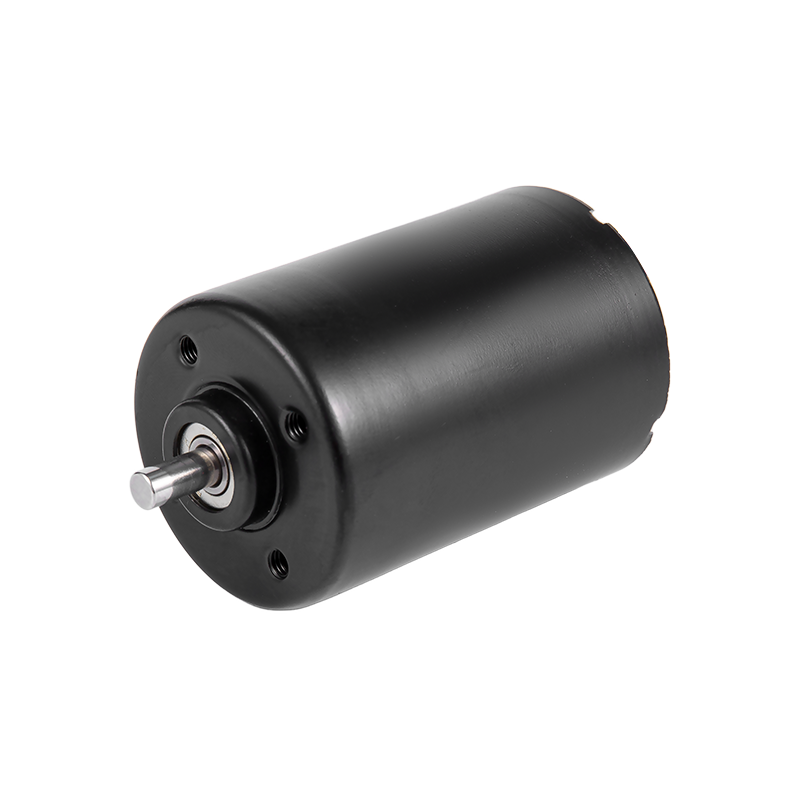
Every brushed DC motor shares a set of components of a DC motor that directly affect efficiency and service life. The table below lists the main parts and their functions. In brushless DC motors (BLDC), the mechanical commutator is replaced by electronic commutation, but the fundamental electromagnetic components remain.
| Component | Material / Type | Key Function |
|---|---|---|
| Stator (field magnet) | Permanent magnet or wound field | Produces a stationary magnetic field |
| Armature (rotor) | Laminated steel core with copper windings | Carries current and generates torque |
| Commutator | Copper segments on armature shaft | Reverses current direction in the armature every half turn |
| Brushes | Carbon or graphite | Transfer current from static leads to rotating commutator |
| Shaft & bearings | Steel shaft, ball or sleeve bearings | Support rotation and reduce friction |
In separately excited DC motors—commonly encountered when dealing with a 4 wire DC motor connection diagram—the field winding is supplied independently from the armature, adding two extra terminals compared to a permanent magnet or series-wound type. This gives precise independent control over field flux and armature current, which is essential for advanced speed and torque control of DC motor applications.
A 4 wire DC motor connection diagram normally represents a separately excited DC motor or a universal motor with accessible field and armature windings. The four terminals are marked A1 and A2 (armature) and F1 and F2 (field). A correct wiring diagram for DC motor of this type separates the armature and field circuits completely. The table below shows the standard connection scheme used in variable speed drives. If you are working with a permanent magnet motor, you will only find two wires, and the field is provided by fixed magnets, simplifying the setup significantly.
| Motor Terminal | Wire Color (Typical) | Connect To |
|---|---|---|
| A1 | Red | Armature supply positive (from H-bridge or PWM driver) |
| A2 | Black | Armature supply negative |
| F1 | White or yellow | Field supply positive (regulated DC, constant voltage or current) |
| F2 | Blue | Field supply negative |
When using a variable speed 12V DC motor with a four-wire configuration, the armature circuit is typically driven by a PWM controller operating at 12 V nominal, while the field circuit receives a stable 12 V (or a lower regulated voltage) to maintain constant field strength. Reversing either the armature connections or the field connections—but never both—will reverse rotation. Some drives also support field weakening: reducing field voltage below nominal increases speed at the cost of torque, a technique used for constant-power operation above base speed.
Precise speed and torque control of DC motor circuits starts with pulse-width modulation. For a variable speed 12V DC motor, a MOSFET-based H-bridge switching at 20 kHz delivers an average voltage from 0 to 12 V. In a tested 12 V, 50 W DC motor, the no-load speed at 100% duty cycle was 3200 RPM. At 50% duty cycle, speed dropped to approximately 1550 RPM while maintaining smooth rotation with less than 2% speed ripple. Torque, however, remained nearly proportional to average current: at 1 A, the motor produced 0.12 Nm; at 3 A, torque reached 0.35 Nm. This linear current-torque relationship makes it straightforward to implement torque limiting by sensing armature current and reducing PWM duty cycle if a preset threshold is exceeded.
Closed-loop control raises performance further. Adding a quadrature encoder to the motor shaft allows a microcontroller to maintain set speed within ±1%. For torque regulation, a current sensor in the armature loop feeds a PI controller that adjusts the PWM signal in real time. In industrial settings, a separately excited motor with a 4 wire DC motor connection diagram gives the additional option of field-oriented control: maintain constant field voltage for high torque at low speed, then weaken the field to extend the speed range. Data shows that reducing field current by 30% can increase top speed by roughly 40%, though available torque drops inversely.
Understanding how does an AC motor work helps clarify the DC motor’s advantages and limits. The most common AC induction motor operates on a rotating magnetic field principle. When three-phase alternating current flows through stator windings spaced 120° apart, it creates a magnetic field that rotates at synchronous speed—1800 RPM for a 4-pole motor on a 60 Hz supply. This rotating field induces current in the rotor bars, and the interaction produces torque. A single-phase induction motor needs a start winding and capacitor to create a phase shift and initiate rotation. Unlike a DC motor, the speed of an induction motor is tightly linked to the supply frequency and slip (typically 2–5% below synchronous speed at full load).
In contrast, a variable speed 12V DC motor changes speed simply by adjusting voltage, and its starting torque can exceed 200% of rated torque without complex drive electronics. AC motors excel at constant-speed, high-power applications, while DC motors—especially brushed and BLDC types—dominate battery-powered and precision servo tasks. The wiring diagram for DC motor setups is also simpler for variable speed: a single PWM controller versus a variable frequency drive needed for AC speed control. Choosing between them comes down to the required speed range, maintenance tolerance, and available power source.
1. Introduction: Deconstructing AC Induction Motor Horsepower The AC Induction Motor is one of the m...
READ MORE1. Introduction In modern industrial automation, data center construction, consumer electronics upgr...
READ MOREStepper motors represent a cornerstone of modern motion control, offering precise positioning and re...
READ MOREThe industrial motor landscape is undergoing a significant transformation, driven by the relentless ...
READ MORERelated Products
Building 10, No.199, Jinfeng Road, Suzhou High-tech, Jiangsu Province, China
+86-133 3869 4967
+86-512 6876 9967
sean@retekmotion.com
rsgrivic@126.com
 WhatsApp
Copyright © Jiangsu Retek Motion Co., Ltd. All Rights Reserved. Custom OEM Industrial Multi Rotor Drone Motors Manufacturers