 Get in touch
 English
 Deutsch
 中文简体
中文简体 Español

1. Introduction: Deconstructing AC Induction Motor Horsepower The AC Induction Motor is one of the m...
READ MOREIndustry News
2026-06-08
Content
AC electric motors convert alternating current electrical energy into mechanical rotation through electromagnetic induction. The operating principle relies on two core components: the stator (the stationary outer assembly of wound copper coils) and the rotor (the rotating inner shaft assembly). When AC voltage is applied to the stator windings, it produces a rotating magnetic field. The rotor — whether a squirrel cage, wound rotor, or permanent magnet assembly — responds to this rotating field and is pulled into motion.
In an induction motor (the most common AC type), the rotating stator field induces a current in the rotor conductors by Faraday's law of electromagnetic induction. This induced current creates its own magnetic field, which interacts with the stator field to produce torque. The rotor never quite catches up to the stator's rotating field — the difference in speed is called slip, typically 2–5% of synchronous speed. It is this slip that sustains the induced current and therefore the torque. At exactly synchronous speed, induction would stop and torque would fall to zero.
Synchronous speed (in RPM) is determined by the supply frequency and the number of magnetic poles: N = (120 × f) ÷ P, where f is frequency in Hz and P is the number of poles. A 4-pole motor on a 60 Hz supply runs at 1,800 RPM synchronous speed; with typical slip, actual shaft speed is approximately 1,725–1,760 RPM.
Three-phase motors are the workhorse of industrial applications. They operate on the same induction principle as single-phase motors, but with a critical advantage: three separate AC voltages, offset 120° apart in time, are fed to three sets of stator windings arranged symmetrically around the stator bore. This produces a naturally rotating magnetic field without any auxiliary starting components — the three phases inherently generate smooth, self-starting rotation from the moment power is applied.
The result is a motor that starts reliably under load, runs with very low torque ripple (the three-phase waveform sums to a nearly constant total), and delivers higher efficiency and power density than an equivalent single-phase design. Three-phase motors account for roughly 70% of all industrial electricity consumption globally, primarily because of this combination of reliability, efficiency (typically 90–97% at full load in IE3/IE4 efficiency classes), and straightforward speed control via variable frequency drives (VFDs).
Three-phase squirrel cage induction motors have no brushes, no commutator, and minimal moving parts beyond the rotor and bearings — which is why they routinely operate for 20,000–40,000 hours between major service intervals in well-maintained installations.
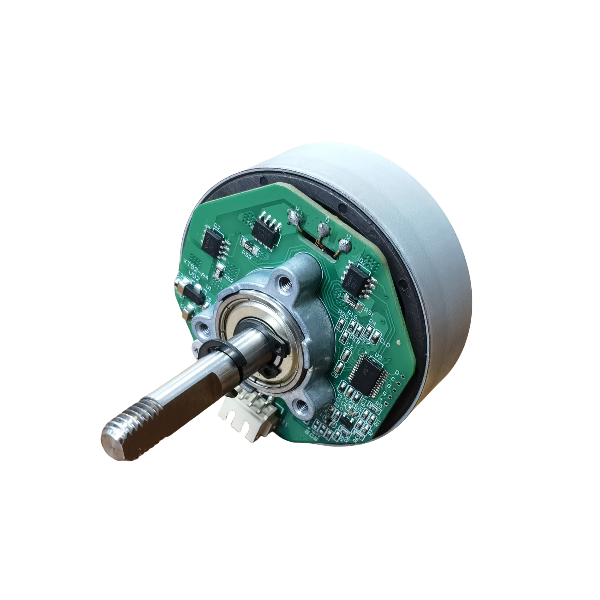
Brushless DC motors (BLDC) replace the mechanical commutator and carbon brush assembly of traditional DC motors with electronic commutation. The rotor carries permanent magnets; the stator carries the windings. A controller — using Hall effect sensors or back-EMF sensing to detect rotor position — switches current to the appropriate stator phases in sequence, maintaining a rotating electromagnetic field that the permanent magnet rotor follows. Because there is no physical brush-commutator contact, brushless motors produce no brush sparking, generate less heat, and require no brush replacement. They achieve efficiencies of 85–95% and are standard in servo drives, EV traction systems, HVAC compressors, and precision automation where speed control accuracy and long service life are required.
Motor torque (T) is the rotational force the shaft delivers, measured in Newton-meters (Nm) or pound-feet (lb·ft). The relationship between torque, power, and speed is:
T (Nm) = P (watts) ÷ ω (rad/s) — or equivalently — T (Nm) = (9,550 × P in kW) ÷ N (RPM)
Example: a 7.5 kW motor running at 1,450 RPM produces T = (9,550 × 7.5) ÷ 1,450 = 49.4 Nm of shaft torque. In imperial units: T (lb·ft) = (5,252 × HP) ÷ RPM. A 10 HP motor at 1,750 RPM delivers T = (5,252 × 10) ÷ 1,750 = 30 lb·ft.
Output horsepower of an electric motor can be calculated from measured shaft torque and speed: HP = (T in lb·ft × RPM) ÷ 5,252. From electrical input, output HP = (V × I × PF × η × 1.732 for 3-phase) ÷ 746, where V is line voltage, I is line current, PF is power factor, and η is efficiency. The 1.732 factor (√3) accounts for the three-phase relationship between line and phase quantities.
Electric motor efficiency (η) is the ratio of mechanical output power to electrical input power: η (%) = (Output power ÷ Input power) × 100. In practice: measure input power (W) with a power analyzer and shaft output power (torque × angular velocity); divide. Losses in a motor include copper losses (I²R heating in windings), iron losses (eddy currents and hysteresis in the core), mechanical losses (bearing friction, windage), and stray load losses. A motor running significantly below its rated load — say at 30–40% of rated capacity — operates at reduced efficiency because fixed iron and mechanical losses remain constant while the useful output fraction shrinks.
| Calculation | Formula | Units |
|---|---|---|
| Torque (metric) | T = (9,550 × kW) ÷ RPM | Nm |
| Torque (imperial) | T = (5,252 × HP) ÷ RPM | lb·ft |
| Output HP from torque | HP = (T × RPM) ÷ 5,252 | HP |
| Efficiency | η = (Output W ÷ Input W) × 100 | % |
| Synchronous speed | N = (120 × f) ÷ P | RPM |
Reversing a three-phase induction motor is straightforward: swap any two of the three supply phase leads at the terminal box or motor starter. Swapping two phases reverses the phase sequence (e.g., from A-B-C to A-C-B), which reverses the direction of the stator's rotating magnetic field — and therefore the rotor's direction of rotation. This can be done by transposing L1 and L2 while leaving L3 unchanged, or any other two-phase swap. The motor does not need to be modified internally. Reversing contactors in a motor starter circuit automate this by energizing alternate phase-swapping contact sets.
Single-phase motors cannot be reversed by simply swapping supply leads — they have no inherent phase rotation to reverse. Direction is determined by the relative polarity of the main winding and the starting (auxiliary) winding. To reverse a single-phase motor, reverse the connections of either the main winding or the start winding — but not both. In practice, most single-phase motors have the start winding leads brought out to the terminal board specifically for this purpose, labeled T5/T8 on capacitor-start and capacitor-run types. Consult the motor's wiring diagram (usually printed on the nameplate cover or inside the terminal box cover) to identify the correct leads before swapping. Reversing direction while the motor is running will damage the start capacitor and starting switch — always stop the motor fully before changing direction.
Testing a DC motor systematically identifies whether problems lie in the windings, insulation, brushes, or commutator before the motor is removed from service or sent for rewind. Use a digital multimeter (DMM) and, for insulation testing, a megohmmeter (megger) rated at 500V or 1,000V DC.
Disconnect all power and discharge capacitors. Measure resistance across the armature terminals with a DMM. Compare the reading to the motor's nameplate or design spec. An open circuit (infinite resistance) indicates a broken winding or lifted brush; very low resistance (near zero) indicates a shorted turn. Resistance readings should be consistent across all commutator segments when measured sequentially — a segment reading significantly higher or lower suggests a localized fault.
Using a 500V or 1,000V megger, measure insulation resistance between each winding and the motor frame (ground). A minimum of 1 MΩ per kV of operating voltage is the baseline acceptance criterion (IEEE 43 standard); values below 1 MΩ indicate moisture contamination, insulation breakdown, or winding damage that will lead to ground faults in service. New motors typically measure 100 MΩ or above. Any reading below 5 MΩ on a motor in service warrants investigation before returning it to operation.
Visually inspect brushes for length (replace when worn to less than half original length or the manufacturer's minimum), and check that brush holders allow free movement without binding. Commutator surfaces should be smooth and evenly colored (a dark, uniform patina is normal; pitting, burning, or uneven wear patterns indicate arcing from a shorted armature segment or incorrect brush grade). Measure brush spring pressure with a spring gauge — low pressure causes arcing and accelerated wear; excessive pressure causes commutator wear.
Systematic troubleshooting follows a fault-symptom logic — identifying what the motor is doing (or not doing) and working through the most probable causes in order of ease of checking.
Thermal degradation of winding insulation is the single largest contributor to motor failure, accounting for an estimated 30–40% of all motor failures in industrial surveys. The widely cited Arrhenius rule for electrical insulation states that every 10°C rise above the insulation's rated temperature class halves its operational lifespan. A Class F insulation motor (rated to 155°C) operated consistently at 165°C will last half as long as one operated within its thermal limit.
Sources of excessive motor heat include: overloading beyond the service factor, blocked or restricted cooling airflow (dirty fins, obstructed inlet, inadequate ventilation in the motor enclosure area), high ambient temperature, voltage unbalance causing elevated current in one or more phases, frequent starts per hour exceeding the motor's thermal rating, and bearing failures that increase mechanical friction. Motors equipped with thermistor or RTD winding temperature sensors can trigger shutdown before thermal damage accumulates — retrofitting temperature protection on critical motors is a cost-effective reliability measure.
As a maintenance practice, measure winding temperature during operation using an infrared thermometer on the motor frame as a proxy, and compare against the motor's ambient-corrected temperature rise rating. A motor running consistently at or near its thermal limit under normal load conditions should be investigated for cooling restriction, incorrect sizing, or supply quality issues before failure occurs.
Motor selection is a multi-variable process. Choosing on horsepower alone — the most common shortcut — regularly produces motors that are oversized, poorly matched to the load profile, or incompatible with the control system. Work through the following criteria in order:
Constant torque loads (conveyors, positive-displacement pumps, mixers) require a motor that delivers rated torque across the full speed range. Variable torque loads (centrifugal pumps, fans, blowers) follow the cube law — power demand drops sharply at reduced speed, making them excellent VFD candidates with significant energy savings potential. Intermittent duty applications (cranes, presses, compressors) require motors with appropriate duty class ratings (S1 through S9 per IEC 60034-1) to handle thermal cycling without premature insulation degradation.
Calculate the load's torque requirement at operating speed (see torque formulas above). Add 10–25% safety margin for starting torque, mechanical losses, and application variability. Select a motor whose rated torque at the operating speed meets or exceeds this value. Avoid oversizing by more than one standard frame size — an oversized motor runs at a low power factor, reduces efficiency, and wastes capital cost.
Enclosure selection is determined by the operating environment. TEFC (Totally Enclosed Fan Cooled, IP55) is the standard for most industrial outdoor and dusty indoor applications. ODP (Open Drip Proof, IP23) suits clean, dry indoor environments and offers better cooling at high ambient temperatures. For wet or washdown environments, IP66 or IP67 ratings are required. Insulation class — F (155°C) is standard for most industrial motors; Class H (180°C) is specified for high-ambient or heavy-duty cycling applications.
Confirm IEC or NEMA frame size compatibility with the mounting arrangement (foot-mounted B3, flange-mounted B5, or combination B35). Verify nameplate voltage and frequency match the available supply — and confirm the motor is VFD-rated (inverter duty) if a variable frequency drive will be used. Standard motors operated on a VFD without inverter-duty insulation experience accelerated winding degradation from voltage spike stress.
1. Introduction: Deconstructing AC Induction Motor Horsepower The AC Induction Motor is one of the m...
READ MORE1. Introduction In modern industrial automation, data center construction, consumer electronics upgr...
READ MOREStepper motors represent a cornerstone of modern motion control, offering precise positioning and re...
READ MOREThe industrial motor landscape is undergoing a significant transformation, driven by the relentless ...
READ MORERelated Products
Building 10, No.199, Jinfeng Road, Suzhou High-tech, Jiangsu Province, China
+86-133 3869 4967
+86-512 6876 9967
sean@retekmotion.com
rsgrivic@126.com
 WhatsApp
Copyright © Jiangsu Retek Motion Co., Ltd. All Rights Reserved. Custom OEM Industrial Multi Rotor Drone Motors Manufacturers