 Get in touch
 English
 Deutsch
 中文简体
中文简体 Español

1. Introduction: Deconstructing AC Induction Motor Horsepower The AC Induction Motor is one of the m...
READ MOREIndustry News
2026-04-08
Content
A brushless motor is an electric motor that generates rotational force through electronically commutated magnetic fields, eliminating the physical carbon brushes and mechanical commutator ring used in conventional brushed motors. Instead of relying on sliding electrical contacts to switch current direction through the rotor windings, a brushless motor uses a dedicated electronic controller — the ESC (electronic speed controller) or BLDC driver — to sequence current through stationary stator windings in precise timing with rotor position. The rotor itself carries permanent magnets and has no electrical connections at all.
This architecture shift has three immediate consequences. First, there is no brush friction or arcing — the dominant source of heat, wear, and efficiency loss in brushed designs. Second, the heat-generating windings are on the stator, which is in direct contact with the motor housing and can be cooled passively or actively; in a brushed motor, heat builds inside the spinning rotor where it is difficult to dissipate. Third, commutation timing can be optimized in software for any operating condition, allowing the motor to run at peak efficiency across a wide RPM and load range. Brushless motors typically achieve 85–95% efficiency, compared to 75–80% for equivalent brushed designs.
The term "brushless motor" most commonly refers to the brushless DC motor (BLDC), which is powered by DC voltage and uses electronic commutation to approximate the rotating magnetic field of an AC motor. Brushless AC motors — including permanent magnet synchronous motors (PMSM) — operate on the same physical principle but are driven by sinusoidal AC waveforms rather than trapezoidal DC switching. In everyday usage, "brushless motor" and "BLDC motor" are used interchangeably across consumer electronics, power tools, drones, electric vehicles, and industrial automation.
Understanding a brushless DC motor diagram requires identifying five functional elements: the stator, the rotor, the permanent magnets, the Hall effect sensors, and the external controller. Unlike a brushed motor diagram — which shows brushes pressing against a segmented commutator ring on the spinning shaft — a BLDC diagram shows all electrical complexity on the stationary outer body, with a simple magnet assembly rotating inside or outside it.
The stator is the fixed outer structure of an inrunner BLDC motor (or the inner ring in an outrunner). It consists of laminated silicon steel cores — stamped into a star or salient pole geometry — wound with copper coils arranged into three phases: Phase A, Phase B, and Phase C. These three phases are connected either in a star (Y) configuration, where all three windings share a common neutral point, or in a delta (Δ) configuration, where windings connect end-to-end in a triangle. Star wiring is more common in BLDC motors because it produces higher torque at low RPM and simplifies the controller design; delta wiring is preferred where maximum high-speed power is the priority.
The number of stator slots and rotor poles defines the motor's fundamental character. A 12-slot, 14-pole configuration (common in drone motors) produces smooth torque with low cogging. A 9-slot, 12-pole design is popular in power tools for its balance of torque density and manufacturing simplicity. Slot and pole count also determines the electrical cycle frequency — a 14-pole motor completes 7 electrical cycles per mechanical revolution, meaning its controller must switch current 7× faster per shaft rotation than a 2-pole motor at the same RPM.
In an inrunner BLDC motor — the standard configuration in power tools, hard drives, and most industrial motors — the rotor sits inside the stator bore. It consists of a steel shaft with permanent magnets mounted on or embedded in its surface. Surface-mounted magnet rotors (SPM) are simpler to manufacture and dominant in lower-cost designs; interior permanent magnet rotors (IPM) embed magnets inside the rotor laminations, enabling higher reluctance torque and better flux weakening for extended speed ranges. Electric vehicle traction motors almost universally use IPM rotor designs.
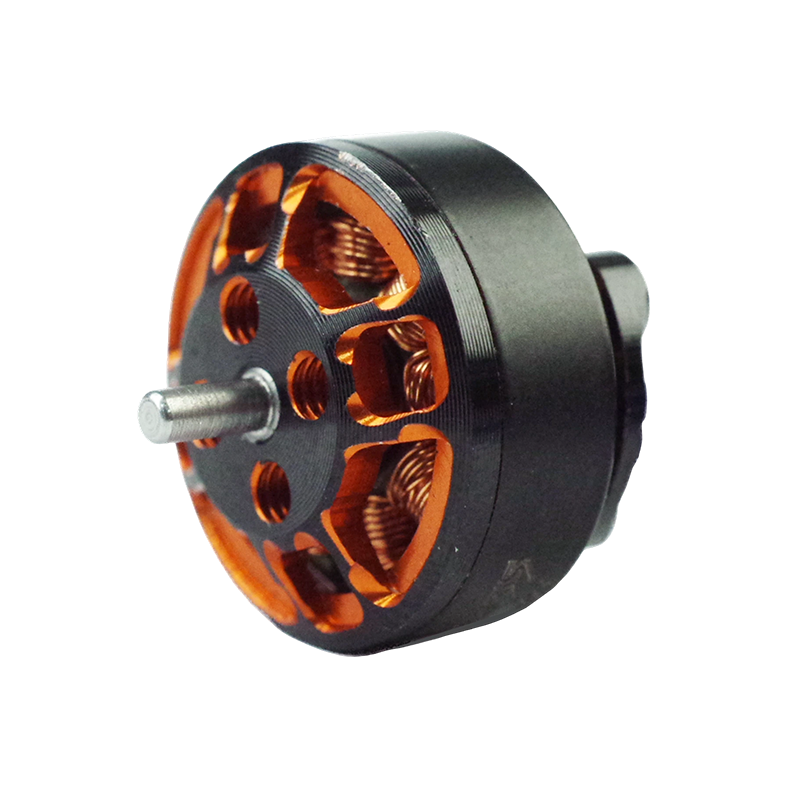
Outrunner BLDC motors invert this geometry: the permanent magnet assembly rotates around the outside of a fixed stator. This gives outrunners a larger moment arm for torque generation and makes them naturally suited to direct-drive applications — drone propellers and electric bicycle hub motors mount the load directly to the spinning outer shell, eliminating gearboxes. Outrunners produce higher torque at lower RPM than equivalent inrunners, while inrunners spin faster and are better matched to high-speed, geared applications.
Most BLDC motors include three Hall effect sensors mounted in the stator at 120° intervals (or 60° in some configurations). Each sensor detects the magnetic field of the passing rotor magnets and outputs a binary signal — high or low — depending on whether a north or south pole is adjacent. The three sensors together produce a 3-bit position code (e.g., 101, 001, 011, 010, 110, 100) that cycles through six unique states per electrical cycle, giving the controller sufficient position resolution to determine which stator phase to energize at any moment. This is the heart of the brushless motor's commutation logic: Hall sensor output → controller decodes rotor position → switches the correct phase pair.
Sensorless BLDC motors omit the Hall sensors entirely and instead detect rotor position by monitoring the back-EMF (electromotive force) generated in the unenergized phase winding as the rotor magnets sweep past. Sensorless designs are simpler, more compact, and less expensive — dominant in drones, PC cooling fans, and appliances — but require the rotor to already be spinning before back-EMF is detectable. This is why sensorless motors need a startup sequence (open-loop forced commutation) before switching to closed-loop back-EMF tracking, and why they can hesitate or fail to start reliably under heavy load.
The operating principle of a brushless motor is electromagnetic attraction and repulsion between the stator's switchable electromagnets and the rotor's fixed permanent magnets. The controller continuously creates a rotating magnetic field in the stator by energizing windings in a specific sequence; the rotor's permanent magnets chase this rotating field, converting the magnetic torque into mechanical shaft rotation.
In a three-phase BLDC motor with trapezoidal commutation — the standard approach for Hall-sensor-equipped motors — only two of the three phases are energized at any moment. The controller's six-step commutation sequence works as follows:
Each step holds the energized field slightly ahead of the rotor's current position — like a carrot perpetually in front of the rotor. The rotor never catches up because as soon as it approaches the current field position, the controller advances to the next step. Speed is controlled by varying the voltage applied to the windings, typically through PWM (pulse-width modulation) on the high-side switches of the controller's three-phase inverter bridge. Torque is controlled by the magnitude of phase current. The relationship between these two variables — and their real-time optimization — is what separates a basic BLDC driver from a sophisticated field-oriented control (FOC) system.
Trapezoidal commutation switches abruptly between the six steps, producing a torque ripple — a periodic variation in output torque — at six times the electrical frequency. At low speeds this ripple creates audible noise and vibration; at high speeds it becomes negligible. Field-oriented control (FOC), also called sinusoidal commutation or vector control, applies continuously varying sinusoidal currents to all three phases simultaneously, creating a perfectly smooth rotating magnetic field. The result is near-zero torque ripple, quieter operation, and 5–15% higher efficiency at partial loads. FOC requires more computational power (a DSP or ARM Cortex microcontroller running at tens of MHz) and precise current sensing on all three phases, which is why it is standard in premium power tools, electric vehicles, and industrial servo drives but less common in cost-sensitive consumer products.
The brushless electric motor diagram versus a brushed motor diagram reveals the core trade-off: brushed motors are mechanically self-commutating (simpler drive electronics, lower system cost) while brushless motors shift complexity to the controller and gain substantial performance advantages in return.
| Parameter | Brushless Motor | Brushed Motor |
|---|---|---|
| Efficiency | 85–95% | 75–80% |
| Service Life | 10,000–30,000 hrs | 1,000–5,000 hrs |
| Maintenance | Bearings only | Brush replacement |
| Torque Density | High | Medium |
| Speed Range | Very wide (0–100,000 RPM) | Limited by brush arcing |
| Controller Cost | Higher (3-phase inverter) | Lower (H-bridge) |
| Noise / EMI | Low | High (brush arcing) |
| Suitable Environments | Including explosive/dusty | Not spark-safe |
Brush arcing is particularly consequential in applications where EMI (electromagnetic interference) is a concern — medical devices, precision measurement equipment, and RF systems. A brushed motor's commutator generates broadband electrical noise across the frequency spectrum that can couple into nearby sensitive circuits. Brushless motors, by contrast, produce switching noise only at the PWM frequency and its harmonics — a manageable, predictable interference source that can be filtered with standard EMI suppression components.
Selecting a brushless DC motor for an application requires interpreting several interdependent specifications that do not appear on brushed motor datasheets. Understanding these figures prevents misapplication — particularly the underestimation of controller requirements, which is the most common specification error in brushless motor system design.
Brushless motors have displaced brushed designs across virtually every performance-critical application over the past two decades, driven by falling controller costs and the demand for longer service intervals and higher power density.
Hard disk drive spindle motors were among the first mass-market brushless applications — the precision speed control and long service life requirements of HDD spindles made brushed motors impractical from the outset. Today, PC cooling fans, washing machine drum motors, robotic vacuum cleaners, and cordless power tools all use BLDC motors as standard. A premium cordless drill with a brushless motor delivers 25–50% more run time per charge versus a brushed equivalent of the same voltage, because the higher efficiency converts more battery energy into useful work rather than heat.
Multirotor drones depend entirely on outrunner BLDC motors — typically three-phase, sensorless, direct-drive — for thrust generation. The combination of high power-to-weight ratio, precise electronic speed control, and absence of maintenance-requiring brushes makes BLDC the only viable propulsion technology for consumer and commercial UAVs. A typical 5-inch FPV racing drone motor (2306 frame size, 2400KV) weighs under 35g and produces over 1kg of thrust at peak current — a power density that brushed motors cannot approach.
EV traction motors are predominantly interior permanent magnet BLDC (or PMSM) designs, controlled by FOC inverters drawing from the high-voltage battery pack. Tesla's rear motor in the Model 3 is a switched reluctance design, but the front motor is a PMSM — chosen for its efficiency across the full speed range of highway driving. The BMW i3 and most Hyundai/Kia EV models use IPM BLDC motors. Peak power outputs range from 150kW in compact EVs to over 500kW in performance applications, all managed by automotive-grade three-phase inverters with microsecond-level switching precision.
Servo motors in CNC machine tools, robotic arms, and conveyor systems are almost exclusively brushless — the combination of FOC control, high-resolution encoders, and closed-loop feedback delivers positioning accuracy to within microns and speed regulation to within 0.01% across load changes. In environments with explosive gases or fine dust (grain processing, chemical plants, mining), brushless motors with sealed housings eliminate the ignition risk of brush arcing, qualifying them for ATEX and IECEx hazardous location certifications that brushed motors cannot meet.
1. Introduction: Deconstructing AC Induction Motor Horsepower The AC Induction Motor is one of the m...
READ MORE1. Introduction In modern industrial automation, data center construction, consumer electronics upgr...
READ MOREStepper motors represent a cornerstone of modern motion control, offering precise positioning and re...
READ MOREThe industrial motor landscape is undergoing a significant transformation, driven by the relentless ...
READ MORERelated Products
Building 10, No.199, Jinfeng Road, Suzhou High-tech, Jiangsu Province, China
+86-133 3869 4967
+86-512 6876 9967
sean@retekmotion.com
rsgrivic@126.com
 WhatsApp
Copyright © Jiangsu Retek Motion Co., Ltd. All Rights Reserved. Custom OEM Industrial Multi Rotor Drone Motors Manufacturers