 Get in touch
 English
 Deutsch
 中文简体
中文简体 Español

1. Introduction: Deconstructing AC Induction Motor Horsepower The AC Induction Motor is one of the m...
READ MOREIndustry News
2026-04-02
Content
A brushless DC motor, commonly abbreviated as BLDC motor, is an electric motor that uses direct current to generate rotational motion without the physical carbon brushes found in conventional DC motors. In a brushed motor, brushes press against a rotating commutator ring to deliver current to the rotor windings — a mechanical contact that creates friction, heat, electrical noise, and wear over time. A brushless motor eliminates this contact entirely by relocating the windings to the stationary outer housing (the stator) and using an electronic controller to switch current between winding phases in the correct sequence, replacing the mechanical commutator with a solid-state equivalent.
The meaning of brushless motor therefore comes down to this fundamental architecture shift: commutation is electronic, not mechanical. The rotor — which carries permanent magnets rather than wound coils — follows the rotating magnetic field produced by the electronically switched stator windings. Because no brushes contact any rotating surface, there is no ongoing mechanical wear from this commutation process, which is the primary source of the motor's longevity and efficiency advantages.
Despite the "DC" designation, a BLDC motor is technically driven by alternating current at its stator windings — the electronic speed controller (ESC) or motor driver converts the DC supply into precisely timed AC phases. The "DC" in the name refers to the DC supply that powers the system, not the current waveform at the windings. This distinction matters when interpreting motor specifications and selecting compatible drive electronics.
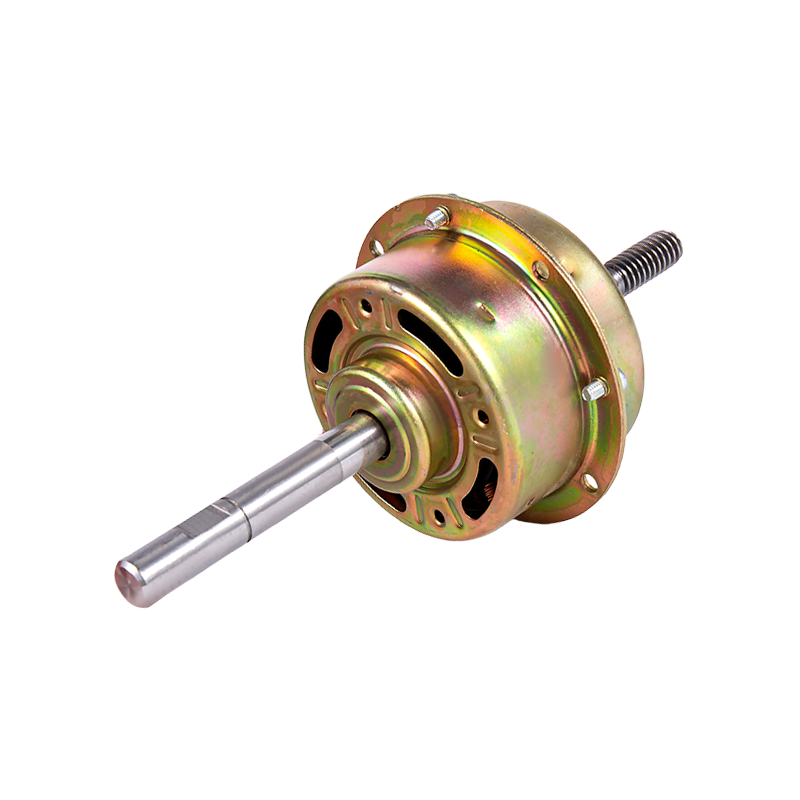
To understand what a brushless electric motor does differently, it helps to trace the commutation sequence. The stator of a BLDC motor contains multiple sets of windings — typically arranged in three phases — distributed around the motor's circumference. When current flows through a winding set, it creates a magnetic field that attracts or repels the permanent magnets on the rotor, generating torque. To sustain rotation, the controller must switch which winding set is energized as the rotor turns, always keeping the magnetic attraction pulling the rotor forward rather than holding it in place.
This switching requires the controller to know the rotor's current angular position at all times. Two methods achieve this:
The quality of commutation timing directly affects motor efficiency and smoothness. Precisely timed phase switching — advancing slightly ahead of the rotor position to account for winding inductance — maximizes torque output per ampere of input current. Poorly timed commutation introduces torque ripple, audible noise, and efficiency losses that add up significantly in continuous-duty applications.
The practical performance differences between a BLDC motor and a brushed DC motor of equivalent size are substantial, though they matter more in some applications than others. The advantages fall into four categories:
The principal trade-off is cost and control complexity. A brushless motor requires a dedicated electronic controller; a brushed motor can be run directly from a DC supply with only a switch and optional resistor for speed control. For low-duty, low-cost applications — simple toys, basic fans, inexpensive appliances — the added controller cost can outweigh the performance benefits, which is why brushed motors remain in production for price-sensitive segments.
Brushless electric motors now appear across virtually every sector where electric drives are used. In consumer products: cordless power tools (drills, circular saws, impact drivers), electric bicycles, robot vacuum cleaners, and drone propulsion systems have largely transitioned to brushless drives over the past decade. In industrial settings: CNC spindles, conveyor drives, servo axes, HVAC compressors, and pump systems rely on BLDC or permanent magnet synchronous motors (PMSM — a closely related topology) for their efficiency and controllability. In automotive: electric power steering, cooling fans, fuel pumps, and the traction motors of hybrid and full electric vehicles are all brushless.
When selecting a BLDC motor for a specific application, the key parameters to specify are:
1. Introduction: Deconstructing AC Induction Motor Horsepower The AC Induction Motor is one of the m...
READ MORE1. Introduction In modern industrial automation, data center construction, consumer electronics upgr...
READ MOREStepper motors represent a cornerstone of modern motion control, offering precise positioning and re...
READ MOREThe industrial motor landscape is undergoing a significant transformation, driven by the relentless ...
READ MORERelated Products
Building 10, No.199, Jinfeng Road, Suzhou High-tech, Jiangsu Province, China
+86-133 3869 4967
+86-512 6876 9967
sean@retekmotion.com
rsgrivic@126.com
 WhatsApp
Copyright © Jiangsu Retek Motion Co., Ltd. All Rights Reserved. Custom OEM Industrial Multi Rotor Drone Motors Manufacturers