 Get in touch
 English
 Deutsch
 中文简体
中文简体 Español

1. Introduction: Deconstructing AC Induction Motor Horsepower The AC Induction Motor is one of the m...
READ MOREIndustry News
2026-04-13
Content
A DC motor is an electromechanical device that converts direct current (DC) electrical energy into rotational mechanical motion. It operates on the fundamental principle of electromagnetism: when a current-carrying conductor is placed within a magnetic field, it experiences a force — and if that conductor is arranged so the force acts tangentially around a central axis, continuous rotation results.
Every DC motor contains two primary magnetic assemblies: the stator (the stationary outer structure that provides a fixed magnetic field, either through permanent magnets or wound field coils) and the rotor (the rotating inner assembly, also called the armature, which carries the current-bearing windings). The interaction between the magnetic fields of the stator and rotor generates torque, driving the shaft.
DC motors are valued across industries for their precise speed control, high starting torque, and compatibility with battery power sources. They are found in applications ranging from electric vehicles and industrial conveyor systems to power tools, consumer electronics, and radio-controlled models. The global DC motor market was valued at approximately USD 14 billion in 2023 and continues to grow driven by electrification trends across transportation and automation.
A brushed DC motor is the classical DC motor architecture, in use for well over 150 years. Its defining feature is the commutator-and-brush system that continuously switches the direction of current through the rotor windings to maintain unidirectional rotation.
Here is how the commutation works: the rotor windings are connected to a segmented copper ring called the commutator, which rotates with the shaft. Two stationary carbon blocks — the brushes — press against the commutator surface under spring tension. As the shaft turns, different commutator segments pass under each brush, automatically reversing current flow through successive winding sections. This mechanical switching keeps the magnetic force acting in the same rotational direction regardless of shaft position.
Despite these limitations, brushed DC motors remain widely used where low cost and simple control outweigh longevity concerns — including toys, basic power tools, automotive window regulators, and low-duty-cycle industrial actuators.
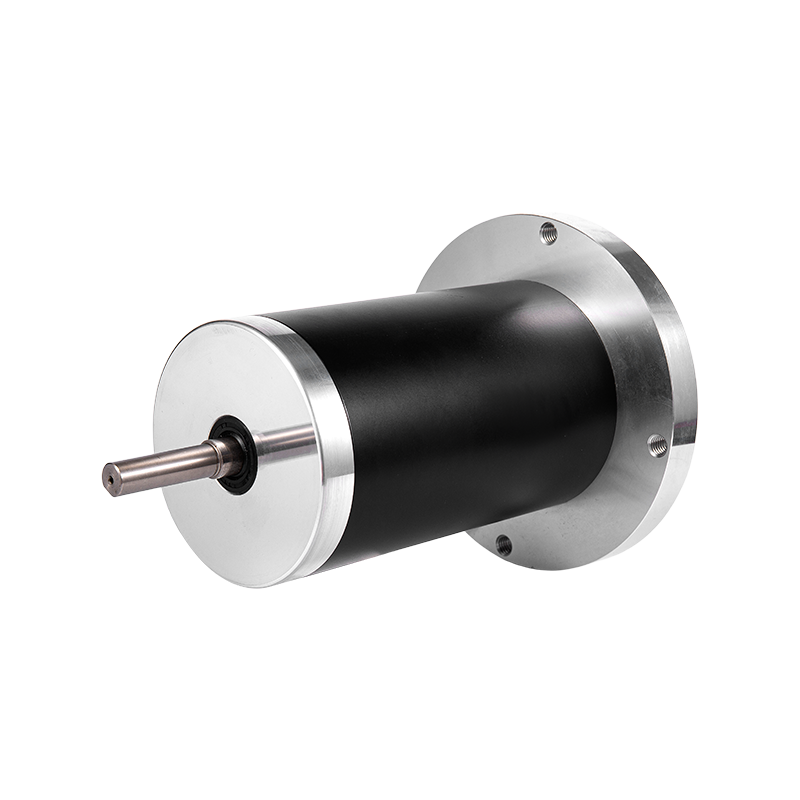
A brushless DC motor (BLDC) eliminates the commutator and carbon brushes entirely by moving the switching function from a mechanical system to an electronic one. In a brushless motor, the permanent magnets are on the rotor and the wound coils are on the stator — the inverse of a brushed motor's arrangement. Because the windings are stationary, there is no need for brushes to transfer current to a rotating element.
Instead, an external electronic speed controller (ESC) monitors the rotor's angular position — typically via Hall effect sensors embedded in the stator, or through sensorless back-EMF detection — and energizes the correct stator coil phases in sequence to maintain rotation. This electronic commutation is precise, virtually instantaneous, and generates no mechanical friction or arcing.
The result is a motor that runs cooler, quieter, more efficiently, and far longer than its brushed equivalent. Brushless motors routinely achieve efficiencies of 85–95%, and with no brush wear, their operational lifespan is limited primarily by bearing fatigue rather than commutation degradation — service lives of 10,000 hours or more are common in well-maintained applications.
The choice between brushed and brushless motors involves tradeoffs across performance, cost, complexity, and application requirements. The comparison below covers the dimensions that matter most in practice:
| Attribute | Brushed DC Motor | Brushless DC Motor |
|---|---|---|
| Commutation method | Mechanical (brushes + commutator) | Electronic (ESC + sensors) |
| Efficiency | 75–85% | 85–95% |
| Lifespan | 1,000–3,000 hours (brush-limited) | 10,000+ hours (bearing-limited) |
| Maintenance | Regular brush inspection and replacement | Minimal — bearing lubrication only |
| EMI / noise | Higher (arcing at brush contact) | Lower (no mechanical switching) |
| Control complexity | Simple — voltage determines speed | Requires ESC; more complex wiring |
| Unit cost | Lower | Higher (motor + ESC) |
| Power density | Moderate | High |
The performance gap between the two types widens under demanding conditions. At high RPM, brushed motors suffer increased arcing and heat buildup at the commutator, accelerating wear precisely when the motor is working hardest. Brushless motors, by contrast, tend to run cooler at high speeds due to the absence of friction losses and the more efficient distribution of heat across the stationary stator windings.
The radio-controlled (RC) hobby market was one of the earliest consumer segments to adopt brushless DC motors at scale, and the transition fundamentally changed what RC vehicles, aircraft, and boats could achieve. Today, brushless motors are the standard in virtually all performance-oriented RC applications, from entry-level sport models to competitive racing platforms.
In RC use, brushless motors are specified by two key parameters: KV rating and stator dimensions. The KV rating (not to be confused with kilovolts) describes the motor's RPM per volt of input — a 2,200 KV motor running on an 11.1V LiPo battery will spin at approximately 24,420 RPM unloaded. Lower KV motors produce more torque at lower speeds (suited to larger propellers or high-traction surface vehicles), while higher KV motors spin faster with less torque (suited to smaller propellers and speed-focused builds).
The shift to brushless in the RC segment also accelerated adoption in adjacent industries. The same motor technology powering competitive RC cars today is directly related to the brushless drives used in commercial drones, robotic actuators, electric skateboard hubs, and cordless power tools — sectors where the RC hobby community's early engineering experimentation effectively served as a proving ground for wider industrial and consumer electrification.
1. Introduction: Deconstructing AC Induction Motor Horsepower The AC Induction Motor is one of the m...
READ MORE1. Introduction In modern industrial automation, data center construction, consumer electronics upgr...
READ MOREStepper motors represent a cornerstone of modern motion control, offering precise positioning and re...
READ MOREThe industrial motor landscape is undergoing a significant transformation, driven by the relentless ...
READ MORERelated Products
Building 10, No.199, Jinfeng Road, Suzhou High-tech, Jiangsu Province, China
+86-133 3869 4967
+86-512 6876 9967
sean@retekmotion.com
rsgrivic@126.com
 WhatsApp
Copyright © Jiangsu Retek Motion Co., Ltd. All Rights Reserved. Custom OEM Industrial Multi Rotor Drone Motors Manufacturers