 Get in touch
 English
 Deutsch
 中文简体
中文简体 Español

1. Introduction: Deconstructing AC Induction Motor Horsepower The AC Induction Motor is one of the m...
READ MOREIndustry News
2026-06-15
Content
An AC motor converts alternating electrical energy into mechanical rotation using electromagnetic induction. The core principle is straightforward: when alternating current flows through the stator windings, it produces a magnetic field that rotates at a speed determined by the supply frequency and the number of pole pairs — this is called the synchronous speed. In a 50 Hz system with a two-pole stator, synchronous speed is 3,000 RPM; at 60 Hz it is 3,600 RPM. With four poles, both figures halve accordingly.
In an induction motor — the most common AC motor type — the rotor is not electrically connected to the supply. Instead, the rotating magnetic field sweeps across the rotor conductors, inducing a voltage by Faraday's law of electromagnetic induction. This induced voltage drives currents through the rotor conductors. Those rotor currents in turn create their own magnetic field, which interacts with the stator field to produce a torque that pulls the rotor in the direction of rotation. The rotor never catches up to the synchronous speed — the difference is called slip, typically 2–8% at full load — because the rotor must continue to cut field lines to sustain induced current and torque. No slip means no induction, no current, no torque.
In a synchronous motor, the rotor is separately excited and locks to the rotating field, running at exactly synchronous speed with zero slip. Synchronous motors are used where precise constant speed is required — generators, large industrial drives, and some servo applications.
Understanding the internal architecture of an AC motor is essential for selection, troubleshooting, and maintenance. The major components are consistent across induction motor types, though construction details vary between single-phase and three-phase designs.
The stator is the stationary outer assembly. It consists of a laminated silicon-steel core — thin sheets (0.35–0.65 mm) stacked and bonded to minimize eddy current losses — with slots punched into the inner bore to accommodate copper windings. The windings are arranged to produce a defined number of magnetic poles when energized. The stator frame, typically cast iron or die-cast aluminum, provides mechanical housing and acts as a heat dissipation path.
The rotor is the rotating inner assembly mounted on the shaft. In a squirrel cage induction motor — by far the most common design — the rotor consists of a laminated core with cast aluminum or copper bars in the slots, short-circuited at both ends by end rings. The name comes from the resemblance to a squirrel exercise wheel. No external connections are needed. In wound-rotor motors, insulated copper windings are connected via slip rings to external resistance, allowing starting torque and speed adjustment.
Deep-groove ball bearings support the shaft radially and axially at both the drive-end and non-drive-end end shields. Bearing quality and lubrication interval are the primary determinants of motor service life. Premature bearing failure from contamination, misalignment, or lubricant starvation accounts for approximately 40–50% of all motor failures in industrial service.
End shields (end bells) close the motor frame at each end, house the bearings, and in TEFC (totally enclosed fan-cooled) motors, support the internal fan baffle. The output shaft transmits torque to the driven load through a coupling, pulley, or direct flange connection. Shaft material is typically medium-carbon steel; stainless steel shafts are specified for food-grade or corrosive environments.
An external fan mounted on the non-drive-end shaft draws air across cooling fins on the frame exterior in TEFC motors. The terminal box provides a weatherproof enclosure for supply connections and, in single-phase motors, capacitor terminals. Terminal boxes are rated by ingress protection (IP) class — IP55 is standard for general industrial use; IP65 or higher for washdown environments.
| Component | Material | Primary Function | Common Failure Mode |
|---|---|---|---|
| Stator core | Laminated silicon steel | Create rotating magnetic field | Winding insulation breakdown |
| Squirrel cage rotor | Aluminum / copper bars | Carry induced rotor current | Broken rotor bars |
| Bearings | Chrome steel (52100) | Support shaft, reduce friction | Fatigue, contamination |
| Capacitor (single-phase) | Polypropylene / electrolytic | Create phase shift for starting/running | Capacitance drift, bulging |
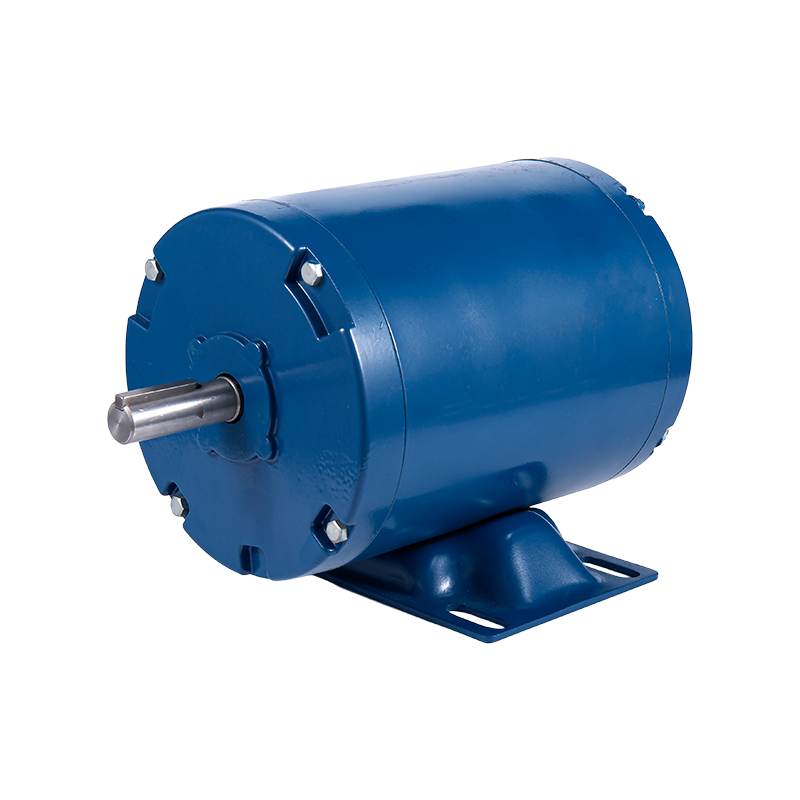
A single-phase induction motor presents a fundamental problem: a single-phase supply produces a pulsating magnetic field, not a rotating one. A pulsating field can be resolved mathematically into two equal and opposite rotating fields that cancel each other out — producing zero net starting torque. The motor has no preferred direction of rotation at standstill and will not start on its own.
Once rotating (in either direction), one of the two counter-rotating field components dominates, and the motor continues to accelerate and run. The challenge is exclusively at startup. All single-phase motor designs solve this the same way in principle: create a second winding displaced spatially in the stator, carry a current in that winding that is phase-shifted relative to the main winding, and together the two currents produce an approximation of a two-phase rotating field sufficient to generate starting torque. The methods differ in how the phase shift is achieved.
In a capacitor-start motor, an electrolytic start capacitor is wired in series with the auxiliary (start) winding. The capacitor shifts the auxiliary winding current approximately 80–90° ahead of the main winding current in phase — close to the 90° ideal for maximum starting torque. Starting torques of 200–350% of full-load torque are achievable. Once the motor reaches approximately 75% of synchronous speed, a centrifugal switch disconnects the start winding and capacitor from the circuit. Running on the main winding alone is adequate because the motor is now self-sustaining.
Standard wiring for a capacitor-start single-phase motor: the main winding connects directly across Line (L) and Neutral (N). The start winding connects in parallel with the main winding, but with the start capacitor wired in series in the start winding branch. The centrifugal switch sits in series with the start winding (after the capacitor) to open the circuit once running speed is reached.
A permanent split capacitor motor uses a single run capacitor that remains in the circuit continuously — both at startup and during normal running. There is no centrifugal switch and no start capacitor. The run capacitor is wired in series with the auxiliary winding and stays energized at all times, continuously splitting the single-phase supply into two phases to maintain a weak rotating field.
The trade-off is reduced starting torque — typically only 30–60% of full-load torque — because run capacitors are sized for running efficiency, not starting performance. PSC motors are therefore suited to low starting-torque applications: fans, blowers, small pumps, and air handlers, where the driven load requires minimal torque to begin moving. In return, PSC motors offer smooth, quiet operation, no centrifugal switch to fail, better power factor than other single-phase types, and higher running efficiency. They are the dominant motor type in HVAC fan coil units and residential furnace blowers.
Wiring for a PSC motor with a 4-wire single-phase connection and capacitor: two terminals connect to the main winding (M1, M2 — typically brown and blue); two terminals connect to the auxiliary winding (A1, A2 — typically red and black). The run capacitor connects between one main winding terminal and one auxiliary terminal, typically M2 and A1. Line and Neutral connect to M1 and M2 respectively. The exact wiring depends on the manufacturer's terminal diagram on the motor nameplate — always verify against the nameplate before connecting.
This design uses both a large electrolytic start capacitor and a smaller film run capacitor. The start capacitor provides high starting torque; the centrifugal switch disconnects it once running speed is reached, leaving only the run capacitor in series with the auxiliary winding. This achieves the best of both types: strong starting torque and efficient running performance. Used in compressors, pressure washers, and other loads requiring both high starting torque and continuous duty efficiency.
Reversing a single-phase induction motor is achieved by swapping the connections of either the main winding or the auxiliary winding relative to the supply — not both. Swapping both windings simultaneously leaves the phase relationship unchanged and does not reverse rotation.
In practice, the auxiliary winding leads are most commonly swapped because they carry less current and the connections are more accessible. On a PSC motor with the standard 4-wire arrangement:
For capacitor-start motors, the same principle applies: reverse the leads of the start winding only. Many single-phase motors are factory-configured for a specific rotation direction and have the start winding leads internally connected — in these cases, reversal is only possible by opening the motor and reconnecting internally, or it may not be reversible at all. Always check the nameplate or wiring diagram before assuming reversibility.
On three-phase motors, reversal is far simpler: swap any two of the three supply phase connections (L1, L2, L3). Swapping L1 and L2 reverses the sequence of the rotating magnetic field, immediately reversing rotor direction.
Fan motors — typically PSC designs — are particularly vulnerable to overheating because their cooling depends on airflow through the fan they drive. If airflow is restricted or the motor is running in a hot environment without adequate ventilation, the consequences follow a predictable and damaging sequence.
The first protection line in most motors is a thermal overload protector — a bimetallic strip or PTC thermistor embedded in or mounted on the stator windings. When winding temperature exceeds the trip threshold (typically 130–150°C for Class B insulation), the protector opens the circuit and shuts the motor down. Auto-reset types restart when the motor cools; manual-reset types require deliberate intervention. Repeated thermal cycling through this protector — the motor gets hot, trips, cools, restarts — is itself destructive: each cycle subjects the winding insulation and capacitor to thermal stress.
If the thermal protector is absent, bypassed, or fails to trip in time, the damage escalates:
Identifying overheating early — through periodic infrared thermometry, current monitoring, or vibration analysis — is far less expensive than replacing a failed motor and diagnosing the root cause post-failure.
A DC motor operates on a fundamentally different principle from an AC induction motor. Where an AC motor uses electromagnetic induction to induce rotor current, a DC motor applies direct current to both the stator field and the rotor (armature) through a direct electrical connection.
The operating principle is the Lorentz force law: a current-carrying conductor in a magnetic field experiences a force perpendicular to both the current direction and the field direction. In a DC motor, the stator creates a stationary magnetic field (via permanent magnets or field windings). Direct current supplied to the armature windings through brushes and a commutator causes each armature conductor to experience a Lorentz force. The sum of these forces on all conductors creates a rotational torque on the armature.
The commutator is the component that reverses the flow of current through the armature conductors at precisely the right moment to maintain consistent torque direction as the armature rotates. It is a segmented cylindrical contact mounted on the shaft, with carbon brushes pressing against it. As the armature rotates, successive commutator segments come into contact with the brushes, ensuring that the current in each conductor always flows in the correct direction relative to the stator field to produce torque in the same rotational direction. Without commutation, a conductor would reach a position where the Lorentz force reversed direction, and net torque would average to zero.
In brushless DC motors (BLDC), the commutation is performed electronically by a controller that sequences current through stationary windings, with permanent magnets on the rotor. This eliminates brush and commutator wear at the cost of requiring motor control electronics.
The torque produced by a DC motor is directly proportional to the armature current and the magnetic field strength. The fundamental torque equation is:
T = K × Φ × Ia
Where T is torque (N·m), K is the motor constant (determined by armature winding geometry, number of poles, and number of conductors), Φ is the magnetic flux per pole (Wb), and Ia is the armature current (A). The motor constant K is sometimes written as (PZA) / (2πA), where P is the number of poles, Z is the total number of armature conductors, and A is the number of parallel paths in the armature winding.
Several important practical relationships follow from this formula:
Low torque, high speed motors are designed to maximize shaft rotational velocity while accepting reduced torque output. This profile is achieved through specific design choices that differ substantially from high-torque motor designs.
In AC induction motors, higher synchronous speeds require fewer pole pairs: a 2-pole motor runs at 3,000 RPM (50 Hz) or 3,600 RPM (60 Hz), while a 4-pole motor runs at 1,500 / 1,800 RPM. Increasing speed beyond standard synchronous speeds requires variable frequency drive (VFD) operation above base frequency — as frequency rises above rated, the motor operates in the flux-weakening region where torque capacity decreases in proportion to the frequency increase, while speed continues to rise. This is the fundamental machine limitation: at constant voltage, flux weakens above base speed, and torque capacity falls.
In DC and BLDC motors, high speed designs use:
Applications include dental handpieces (400,000 RPM), CNC spindles (20,000–60,000 RPM), centrifugal blowers, turbomolecular vacuum pumps, and high-speed grinding spindles. At these speeds, the driven tool or impeller provides the effective load; torque requirements are modest, but maintaining precise speed and minimizing runout are critical.
The answer depends on the motor type — and the question has different meanings in AC and DC contexts.
In a DC motor, current direction through any individual armature conductor is reversed by the commutator and brush assembly. As the armature rotates, each commutator segment passes under the brush contact in sequence. When a conductor crosses the neutral plane — the position where the magnetic field exerts no tangential force — the brush contact transfers from one commutator segment to the next, and the current in that conductor reverses direction. This mechanical switching action, occurring many times per revolution, maintains unidirectional torque despite the physical rotation of the conductors through alternating field polarities. Carbon brushes press against the rotating commutator under spring tension; brush-to-commutator contact resistance and brush material (copper-carbon, electrographite, or silver-graphite grades) influence commutation quality and brush life.
In an AC induction motor, the current in the stator windings reverses naturally at the supply frequency — 50 or 60 times per second — because the supply voltage itself is alternating. No mechanical switching is needed. The rotor current is induced and self-reversing in proportion to slip. There is no commutator in an AC induction motor.
In a brushless DC (BLDC) motor, the function of the commutator is performed by the electronic speed controller (ESC) or motor drive, which uses power transistors (typically MOSFETs or IGBTs) to switch current through each stator phase in the correct sequence based on rotor position feedback from Hall effect sensors or back-EMF sensing. The controller reverses current direction in each winding pair at the appropriate rotor angle, replicating what the commutator does mechanically — but without wear, without arcing, and at efficiencies above 95% in premium designs.
1. Introduction: Deconstructing AC Induction Motor Horsepower The AC Induction Motor is one of the m...
READ MORE1. Introduction In modern industrial automation, data center construction, consumer electronics upgr...
READ MOREStepper motors represent a cornerstone of modern motion control, offering precise positioning and re...
READ MOREThe industrial motor landscape is undergoing a significant transformation, driven by the relentless ...
READ MORERelated Products
Building 10, No.199, Jinfeng Road, Suzhou High-tech, Jiangsu Province, China
+86-133 3869 4967
+86-512 6876 9967
sean@retekmotion.com
rsgrivic@126.com
 WhatsApp
Copyright © Jiangsu Retek Motion Co., Ltd. All Rights Reserved. Custom OEM Industrial Multi Rotor Drone Motors Manufacturers