 Get in touch
 English
 Deutsch
 中文简体
 Español


1. Introduction: Deconstructing AC Induction Motor Horsepower The AC Induction Motor is one of the m...
READ MOREIndustry News
2026-11-19
Content
In the world of FPV racing, the power system directly dictates your lap times. As tracks demand longer straightaways and higher corner-exit speeds, pilots are no longer satisfied with a FPV racing drone motor that is merely "good enough"—they demand millisecond-level throttle response and explosive power. Among various stator specifications, the 2207 has consistently remained the mainstream choice for racing frames due to its physical advantages in peak power and high-RPM response. In this article, we will analyze the physical characteristics of the 2207 stator and, using the complete step-test data of a star 2207 product (1960KV), break down exactly what kind of power curve and efficiency boundaries a true racing-grade FPV racing drone motor should possess.
The model number of an FPV motor directly corresponds to its stator geometry: the first two digits "22" represent a 22 mm stator diameter, and the last two digits "07" represent a 7 mm stator height. Unlike the 2306, which leans toward mid-to-low-end torque linearity, the 2207 adopts a "narrower diameter, taller height" configuration. This allows for longer copper wire windings and a larger effective conductive cross-section, meaning it can withstand and utilize higher instantaneous currents while offering a better thermal foundation during sustained high-throttle conditions.
Reflected in flight feel, the 2207's power output typically exhibits a distinct "late-stage burst" characteristic: the thrust growth in the first 50% of throttle is relatively restrained. However, once you enter the high-throttle range, the thrust curve rises steeply. This is the exact confidence needed for corner exits and overtaking at the end of a straightaway.
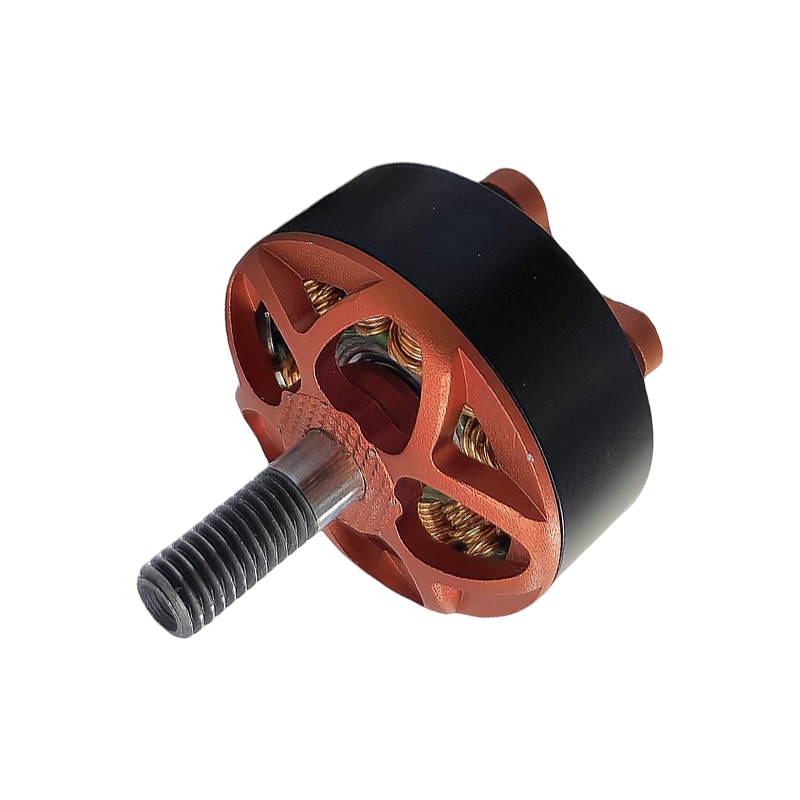
The 2207 star model used as our sample translates this physical trait into concrete parameters: it features a 12N14P configuration, a weight of merely 34.6 g including wires, and was tested with 4-inch props under a nominal 1960KV rating, completing a full step test from 10% to 100% throttle. This lightweight design leaves precious margin for the overall thrust-to-weight ratio of the build.
To judge whether a FPV racing drone motor is genuinely suited for racing, you cannot just look at the peak thrust number; you must look at the thrust climb slope in the mid-to-high throttle range. Below is the full throttle-domain test data for this 2207 1960KV motor under a 6S voltage platform with 4-inch props:
| Throttle (%) | Voltage (V) | Current (A) | RPM | Thrust (kg) | Power (W) | Efficiency (g/W) |
| 10 | 25.17 | 0.006 | 0.9 | 0 | 0 | — |
| 20 | 25.16 | 0.273 | 4903.2 | 0.02 | 2 | 15.515 |
| 30 | 25.11 | 1.331 | 9742.0 | 0.17 | 17.0 | 9.732 |
| 40 | 25.04 | 3.168 | 13573.9 | 0.25458 | 47.3 | 5.383 |
| 50 | 24.93 | 5.897 | 16689.0 | 0.30404 | 90.4 | 4.460 |
| 60 | 24.75 | 10.132 | 19859.7 | 0.59892 | 156.8 | 3.823 |
| 70 | 24.54 | 15.128 | 22347.1 | 0.79432 | 226.6 | 3.359 |
| 80 | 24.28 | 21.369 | 24859.5 | 0.97760 | 322.9 | 3.029 |
| 90 | 24.07 | 29.014 | 26792.4 | 1.15828 | 412.2 | 2.818 |
| 100 | 23.92 | 32.976 | 27519.0 | 1.22285 | 449.9 | 2.718 |
From 10% to 50% throttle, the RPM climbs from under 1,000 to 16,689 RPM, and thrust slowly rises to approximately 0.30 kg. This range primarily serves for in-flight attitude micro-adjustments and small corrections, with power output being gentle and controllable. The real watershed moment occurs after 60% throttle: RPM breaks through 19,800, thrust jumps to around 0.60 kg, and current simultaneously leaps from 5.9 A to over 10 A.
During the final 20% throttle range (80% to 100%), thrust pushes from 0.98 kg to 1.22 kg, current surges from 21 A to nearly 33 A, and power maxes out from 323 W to 450 W. This "steep climb in the final stage" thrust curve is the core value of the 2207 racing stator—it reserves the most violent power for the exact moment the pilot pins the throttle.
Under peak conditions, the motor outputs 32.976 A of current, 449.9 W of input power, and 1.22285 kg of single-axis thrust on a 23.92 V platform, corresponding to an efficiency of 2.718 g/W. In the 2207 1960KV spec range, a sustained current of around 33 A and peak power controlled at the 450 W level at 100% throttle represents a rather conservative tuning approach. It doesn't push the current past 40 A for the sake of paper thrust; instead, it preserves ESC margin and battery voltage stability while delivering 1.2 kg-class thrust. For a 5-inch racing quad, nearly 4.9 kg of combined instantaneous thrust across four axes covers the vast majority of corner-exit ejection and straightaway sprint requirements. Meanwhile, the lower peak current means voltage sag is more controllable, and the late-stage power decay arrives later.
A 34.6 g all-up weight places it on the lighter side of the 2207 camp. In racing flights, every gram of rotor mass reduction translates directly into faster RPM acceleration and sharper throttle response. A lighter motor bell and rotor also mean lower rotational inertia; during continuous direction changes and rapid attitude switches, the gyroscopic torque the flight controller must overcome is lower. The 12N14P slot-pole combination achieves a mature balance between torque smoothness and high-RPM efficiency. Coupled with a 4 mm shaft and 20AWG silicone wire, its installation compatibility covers mainstream 5-inch racing frames.
Looking at the voltage platform, the test shows voltage dropping slowly from 25.17 V to 23.92 V throughout the run—a decline of about 5%. This indicates that even at a peak current of 33 A, the battery can still maintain a relatively stable bus voltage, which is crucial for a 6S racing system to maintain RPM at the end of a straightaway. One of the modern design trends for FPV racing drone motors is optimizing electromagnetic schemes around 6S platforms—using high voltage to drive moderate-KV motors, achieving target RPM while keeping operating current low, thus reducing the heat erosion on sustained output. The current control of this 1960KV sample across the full throttle range is entirely consistent with this technical direction.
The true quality of a racing-grade FPV racing drone motor is ultimately revealed in the few seconds when the throttle is pinned: whether the RPM climbs decisively, whether thrust continuously delivers in the late stage, and whether the current remains within the limits of the ESC and battery. This 2207 1960KV sample delivers a racing answer skewed toward efficiency and controllability, backed by 1.22285 kg of peak single-axis thrust, 32.976 A peak current, and a 34.6 g weight. For pilots who pursue stable output at the end of the straightaway and do not want their voltage to collapse prematurely on the final half-lap, this "honest peak, solid late-stage" power curve is far more meaningful in actual combat than simple thrust numbers.
1. Introduction: Deconstructing AC Induction Motor Horsepower The AC Induction Motor is one of the m...
READ MORE1. Introduction In modern industrial automation, data center construction, consumer electronics upgr...
READ MOREStepper motors represent a cornerstone of modern motion control, offering precise positioning and re...
READ MOREThe industrial motor landscape is undergoing a significant transformation, driven by the relentless ...
READ MORERelated Products
Building 10, No.199, Jinfeng Road, Suzhou High-tech, Jiangsu Province, China
+86-133 3869 4967
+86-512 6876 9967
sean@retekmotion.com
rsgrivic@126.com
 WhatsApp
Copyright © Jiangsu Retek Motion Co., Ltd. All Rights Reserved. Custom OEM Industrial Multi Rotor Drone Motors Manufacturers