 Get in touch
 English
 Deutsch
 中文简体
 Español


1. Introduction: Deconstructing AC Induction Motor Horsepower The AC Induction Motor is one of the m...
READ MOREIndustry News
2026-11-03
Content
A brushless motor is a motor that switches winding current electronically instead of with carbon brushes rubbing on a commutator. Take the brush pair away and three problems leave with it: brush dust, brush wear, and the arcing that keeps brushed motors out of sealed or spark-sensitive equipment. What arrives in their place is a rotor position sensor, a three-phase inverter, and a set of specifications that has to be right the first time.
Jiangsu Retek Motion Co., Ltd. has designed and built brushless DC motors in-house since 2018 across a 28 mm to 130 mm frame range, and the notes below follow the questions that actually come up in an RFQ: what the machine is, what the datasheet constants mean, and where a brushed motor is still the cheaper correct answer.
A brushless motor is a permanent-magnet synchronous machine whose windings sit on the stator and whose magnets rotate, with an electronic drive reversing the current in each phase in step with rotor position.
In a brushed DC motor the winding turns with the rotor, a segmented commutator reverses the current in each coil twice per revolution, and carbon brushes carry the full armature current while sliding. A brushless motor inverts that layout. The copper moves into stator slots, the rotor becomes a magnet assembly, and the inverter does the reversing. Current never crosses a sliding contact, so there is no commutator film to maintain and no brush length to inspect at service intervals.
Brushless motor (BLDC): a permanent-magnet machine with a wound stator, a magnet rotor, and electronic commutation driven by Hall sensors, an encoder, or back-EMF estimation. Ratings and thermal limits follow IEC 60034-1; efficiency is measured under IEC 60034-2-1.
The two names refer to back-EMF shape and commutation scheme, not to different machines. A trapezoidal back-EMF driven with six-step commutation is sold as a BLDC motor; a sinusoidal back-EMF driven with sinusoidal or field-oriented control is sold as a PMSM. Concentrated windings usually produce the trapezoidal shape and distributed windings the sinusoidal one, and one lamination can serve both.
Brushless motor performance is set by five components: lamination steel and stack length, magnet grade, winding turns and wire gauge, rotor position feedback, and the continuous current the drive can supply.
One structural variant matters more than the rest when the load is sensitive to ripple. In a slotless design the winding is a self-supporting cup with no iron teeth facing the magnets, which removes cogging torque and drops rotor inertia. The trade-off is lower torque per unit of volume than an iron-core stator of the same diameter.
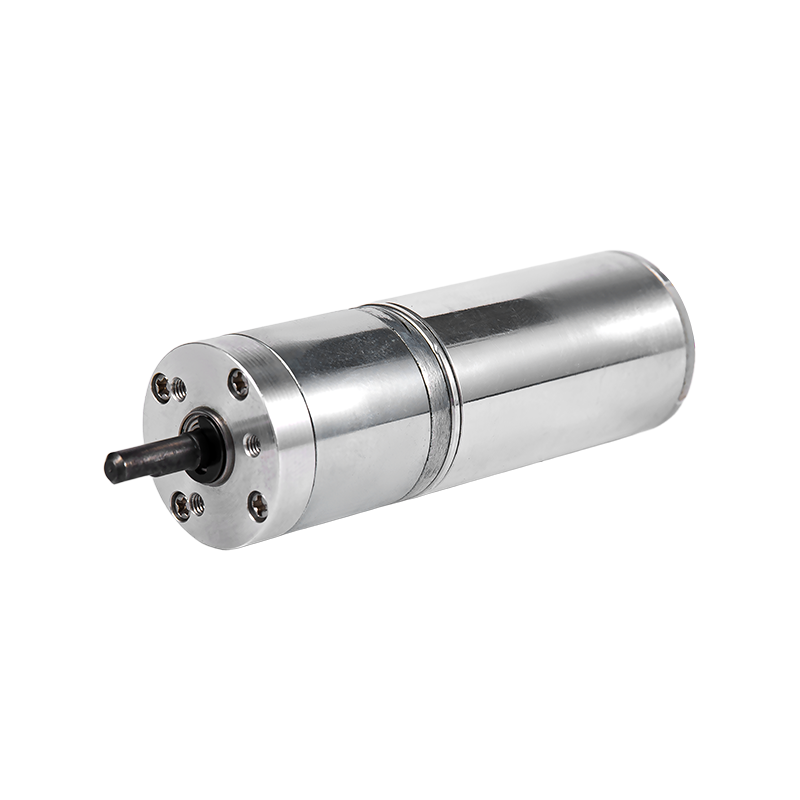 Coreless Brushless DC Motor 22mm Diameter WC 22 SeriesProduct Definition: This coreless brushless DC motor, with a 22mm diameter, is designed for high-efficiency performance in small, compact systems, providing smooth and...View Product →
A brushless motor outlasts a brushed motor on the same duty cycle because it has no sliding electrical contact, but it costs more and will not turn a single revolution without a drive.
| Attribute | Brushed DC | Brushless DC |
| Commutation | Mechanical, commutator and brushes | Electronic, inverter plus rotor feedback |
| Wear parts | Brushes and commutator film | Bearings only |
| Typical full-load efficiency | 70% to 80% | 85% to 92% with field-oriented control |
| Continuous speed ceiling | Usually below 10,000 rpm because of arcing | Above 100,000 rpm in slotless designs |
| Wiring | Two leads | Three phase leads plus five or six sensor leads |
| Electrical noise | Broadband EMI from arcing | Switching noise, filterable at the drive |
Typical full-load efficiency bands for 50 W to 500 W motors, from manufacturer datasheets. Compare only at equal frame size and thermal class.
The efficiency gap is a side benefit, not the main argument. The main argument is the service interval: a brushed motor's maintenance schedule is set by brush length, while a brushless motor's is set by bearing life.
Torque in a brushless motor is proportional to current, speed is set by the back-EMF, and in SI units the torque constant Kt in Nm/A equals the back-EMF constant Ke in V per rad/s.
That equality is the most useful line on any datasheet. If a supplier quotes Ke as 12 V per 1,000 rpm, divide by 104.72 to convert: 12 / 104.72 = 0.1146 V per rad/s, so Kt is 0.1146 Nm/A and the motor needs 5.2 A of torque-producing current to hold 0.6 Nm.
Kt in Nm/A and Ke in V per rad/s are the same number. Convert any V per 1,000 rpm figure first, then read torque straight off the current.
Winding choice trades speed against current. Doubling the turns doubles Kt and halves the no-load speed at the same bus voltage, and because the same torque then needs half the current, copper loss at that torque roughly halves too. The limit is slot fill: past a point the wire stops fitting and the gain disappears.
Cogging is the specification that gets overlooked. Slot and pole combinations such as 12 slots and 10 poles keep cogging low by design, and magnet shaping or skew takes it further. Where the load is a precision positioner or a hand-held tool, the difference is both audible and measurable.
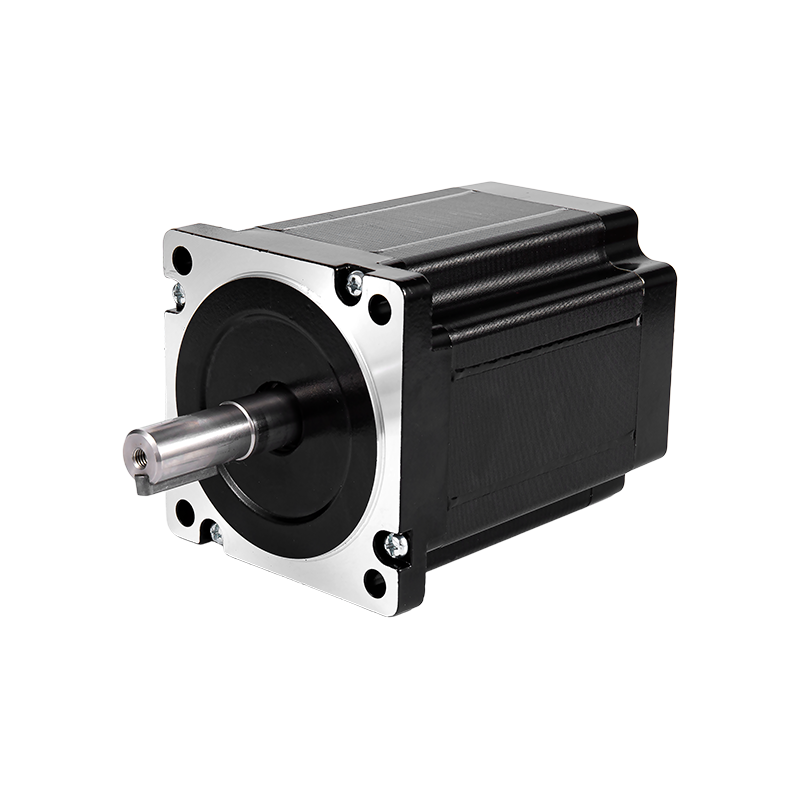
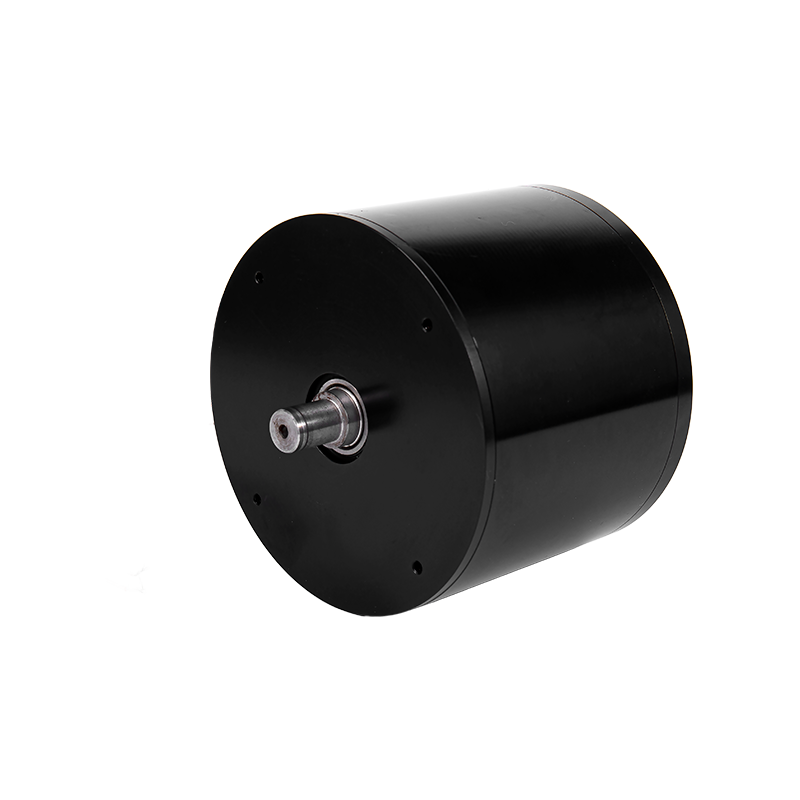 BL112 Low-Cogging 112 mm Brushless DC MotorA 112 mm, 24 VDC, 600 W brushless motor built for low cogging, smooth operation and reduced vibration in precision motion applications.View Product →
Where a gearbox rather than the motor sets the torque ceiling, the high torque brushless DC motor range pairs the same stator platform with planetary, worm and harmonic reducers.
Sensored control works from zero speed at extra wiring cost, while sensorless control removes the sensor harness but cannot start a loaded shaft from standstill because back-EMF is zero at zero speed.
Six-step commutation switches the bridge through six states per electrical cycle and suits trapezoidal machines and low-cost fan drives. Field-oriented control transforms phase currents into a rotating frame, holds the d-axis current at zero, and delivers smoother torque for servo work. A growing share of applications use a motor with an integrated controller, so the inverter and the windings are matched and tested as one unit instead of being debugged on a bench.
A brushless motor inquiry needs eight numbers: frame diameter, bus voltage, continuous torque, peak torque and its duration, speed, duty cycle, ambient temperature, and IP rating.
| Frame | Supply | Typical equipment |
| 28 mm to 36 mm | 12 V to 24 V DC | Power tools, digital tools, hand-held devices |
| 42 mm | 24 V DC | Robotic lawn mowers, medical robotics with gearhead |
| 57 mm to 60 mm | 24 V DC | Pumps, blowers, general automation |
| 80 mm | 24 V DC, IP65 | Washdown and food-processing equipment |
| 86 mm square | 310 V DC | Industrial drives with a rectified front end |
| 112 mm | 24 V DC, 600 W | Low-cogging drives needing torque at low speed |
| 130 mm | 230 V AC input, 2 kW | Industrial axial blowers |
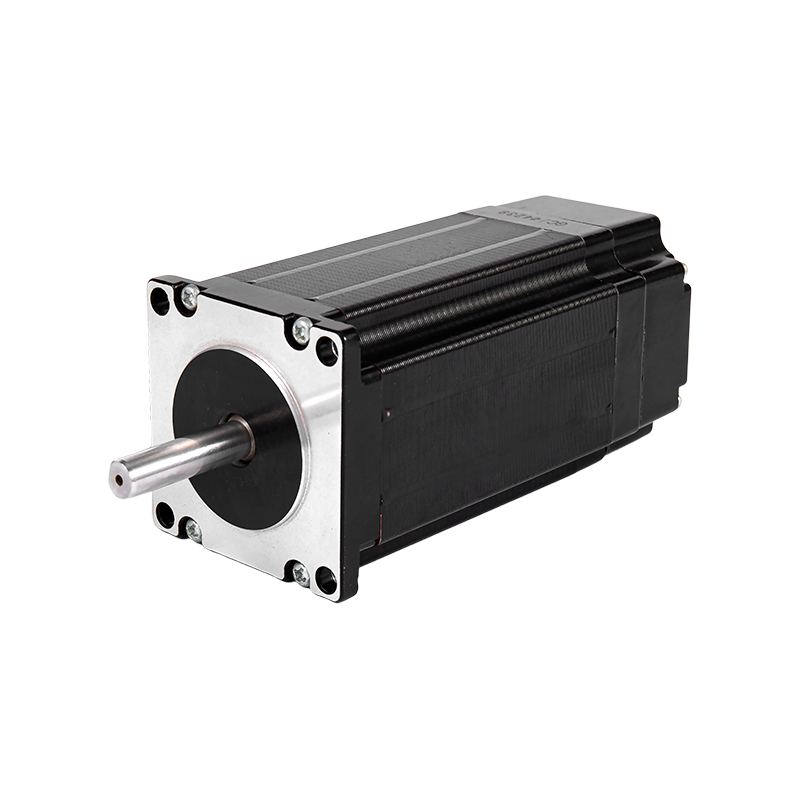
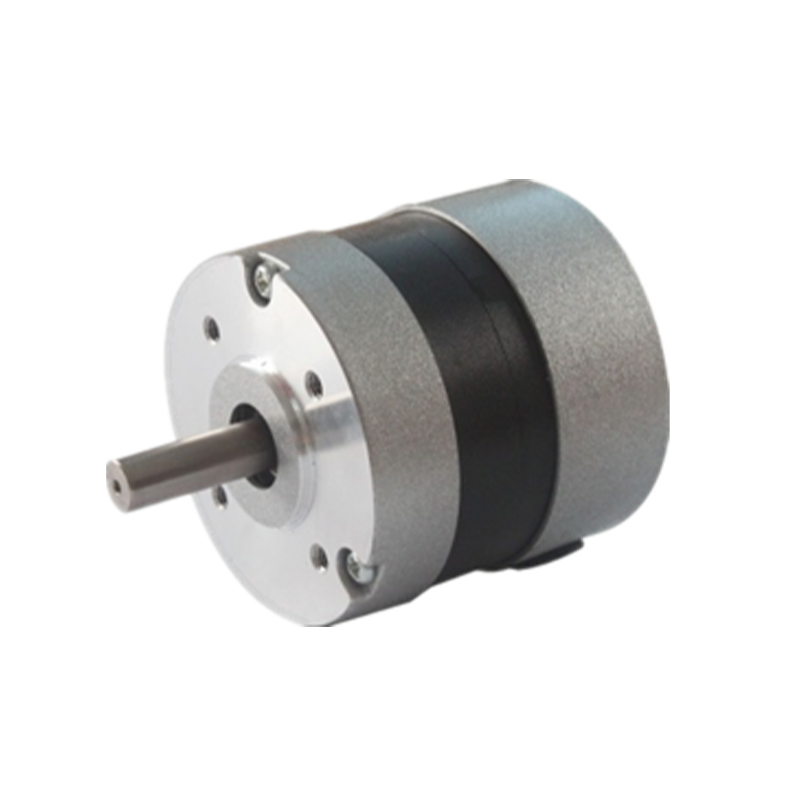 BL57 57 mm Brushless DC MotorA compact 57 mm brushless DC motor designed for high efficiency, high power density, long service life and reduced noise in motion applications.View Product →
Two numbers are missing from most first inquiries and cause the most rework: duty cycle and ambient temperature. A motor rated continuously at 25 C will not hold the same torque inside a 60 C enclosure, and the hot-spot limit of the insulation class decides how much of that margin survives.
A brushless motor is the wrong choice when the machine has no space for a drive, when ambient at the motor exceeds about 150 C, or when annual volume is too low to pay back the electronics.
Cost rule of thumb: below about 100 W and below a few thousand units a year, a brushed DC motor usually wins on landed cost. Above that, the removed maintenance and the efficiency gain pay back the drive inside the warranty period.
Both descriptions can be correct. The machine is synchronous and the stator sees alternating current produced by the inverter, while the input to the drive is usually DC, which is why the family is called brushless DC. A 230 V AC brushless fan motor simply carries a rectifier and an inverter in the same housing.
Bearings, not windings. With no brushes to wear, the bearing becomes the service item, and its life is calculated under ISO 281 as an L10 rating from load and speed. Continuous-duty industrial designs commonly target 20,000 hours to 40,000 hours of bearing life.
Yes, if the load does not demand full torque at standstill. Sensorless drives estimate rotor position from back-EMF zero crossings, which requires the rotor to be turning at roughly 5% of rated speed or faster. Fans, pumps and compressors are routine sensorless applications; robotics and positioners are not.
The windings must be switched in sequence with rotor position, and that sequence is the controller's job. Without it there is no rotating field, so no torque. The controller also carries current limits, the speed loop and protection, which is why drive and motor are usually specified together.
1. Introduction: Deconstructing AC Induction Motor Horsepower The AC Induction Motor is one of the m...
READ MORE1. Introduction In modern industrial automation, data center construction, consumer electronics upgr...
READ MOREStepper motors represent a cornerstone of modern motion control, offering precise positioning and re...
READ MOREThe industrial motor landscape is undergoing a significant transformation, driven by the relentless ...
READ MORERelated Products
Building 10, No.199, Jinfeng Road, Suzhou High-tech, Jiangsu Province, China
+86-133 3869 4967
+86-512 6876 9967
sean@retekmotion.com
rsgrivic@126.com
 WhatsApp
Copyright © Jiangsu Retek Motion Co., Ltd. All Rights Reserved. Custom OEM Industrial Multi Rotor Drone Motors Manufacturers