 Get in touch
 English
 Deutsch
 中文简体
中文简体 Español

1. Introduction: Deconstructing AC Induction Motor Horsepower The AC Induction Motor is one of the m...
READ MOREIndustry News
2026-05-13
Content
A direct current (DC) electric motor is a machine that converts DC electrical energy into rotational mechanical energy. It operates on the principle that a current-carrying conductor placed in a magnetic field experiences a force — and by arranging conductors, magnets, and a switching mechanism correctly, this force can be sustained continuously in one rotational direction to produce useful torque and speed at an output shaft.
DC motors were the first electric motors developed for practical industrial use, pioneered in the 1830s by inventors including William Sturgeon and Thomas Davenport, and became the dominant motor type throughout the 19th and early 20th centuries before AC motor technology matured. Today, DC motors remain essential across automotive systems, portable power tools, battery-operated devices, electric vehicles, and precision motion control — applications where controllable speed and torque from a DC power source are primary requirements.
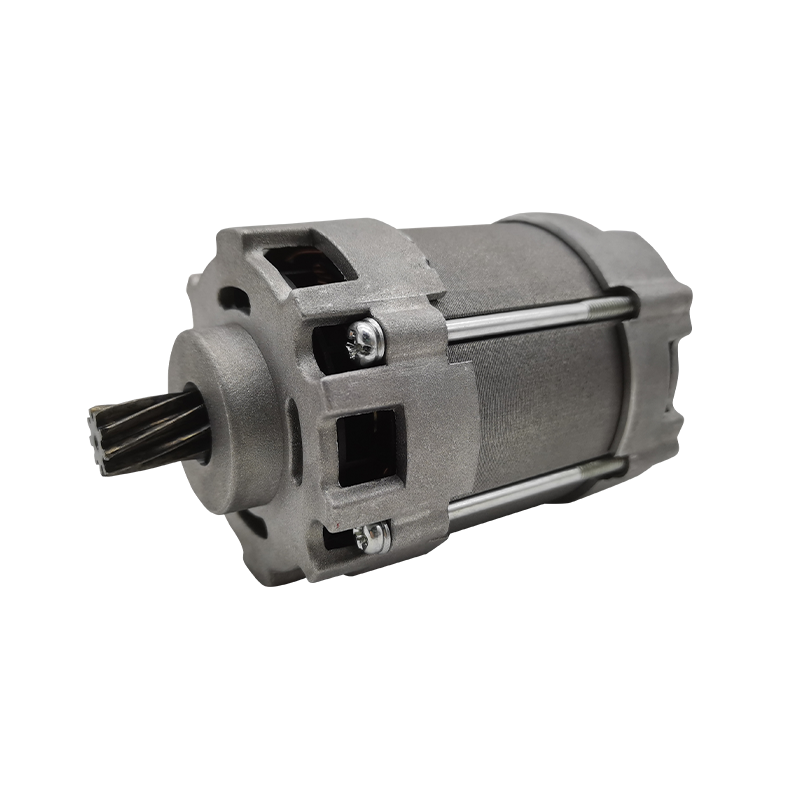
The classical DC motor — the brushed type — demonstrates the operating principle most clearly. Its key components are the armature (rotor), the field system (stator), the commutator, and the brushes.
The armature is the rotating component, consisting of a laminated iron core wound with copper conductors. When DC current flows through these conductors within the magnetic field provided by the stator, each conductor experiences a Lorentz force. The conductors are arranged so that all forces act tangentially in the same rotational direction, producing a net torque that spins the armature.
The fundamental challenge is that as the armature rotates, the conductors move through the magnetic field and their position relative to the poles changes. Without correction, the force direction would reverse after 180° of rotation, stopping and reversing the motor. The commutator solves this: it is a segmented copper ring mounted on the armature shaft, with each segment connected to a different armature winding. As the armature rotates, the commutator segments pass under stationary carbon brushes that maintain electrical contact with the external circuit. The commutator geometry ensures that current is always flowing in the correct direction through whichever conductors are in the optimal torque-producing position — effectively reversing the current in each winding at precisely the right moment to maintain continuous unidirectional rotation.
In a series motor, the field winding and armature winding are connected in series — the same current flows through both. This produces very high starting torque because at low speed, high current flows through the field, creating a strong magnetic field and thus high force on the armature conductors. However, speed rises sharply as load decreases, and a series DC motor running with no load can reach dangerously high speeds (a condition called "running away"). Series motors are used in applications demanding high starting torque: electric traction (trains, trams), cranes, hoists, and starter motors in combustion engines.
In a shunt motor, the field winding is connected in parallel (shunt) with the armature across the supply voltage. Because the field voltage is constant, the field flux is essentially constant regardless of load current. This gives the shunt motor its defining characteristic: relatively constant speed across a wide load range. Speed regulation — the percentage change in speed from no load to full load — is typically 5–15% in a well-designed shunt motor. Shunt motors are suited to machine tools, lathes, milling machines, and fans where constant speed under varying load is required.
A compound motor combines both series and shunt field windings, blending the high starting torque of the series configuration with the speed stability of the shunt. Cumulative compounding (fields aiding) produces high starting torque with reasonable speed regulation. Differential compounding (fields opposing) gives very flat speed characteristics but is rarely used due to instability risks. Compound motors serve presses, punches, elevators, and other loads that require both good starting torque and stable running speed.
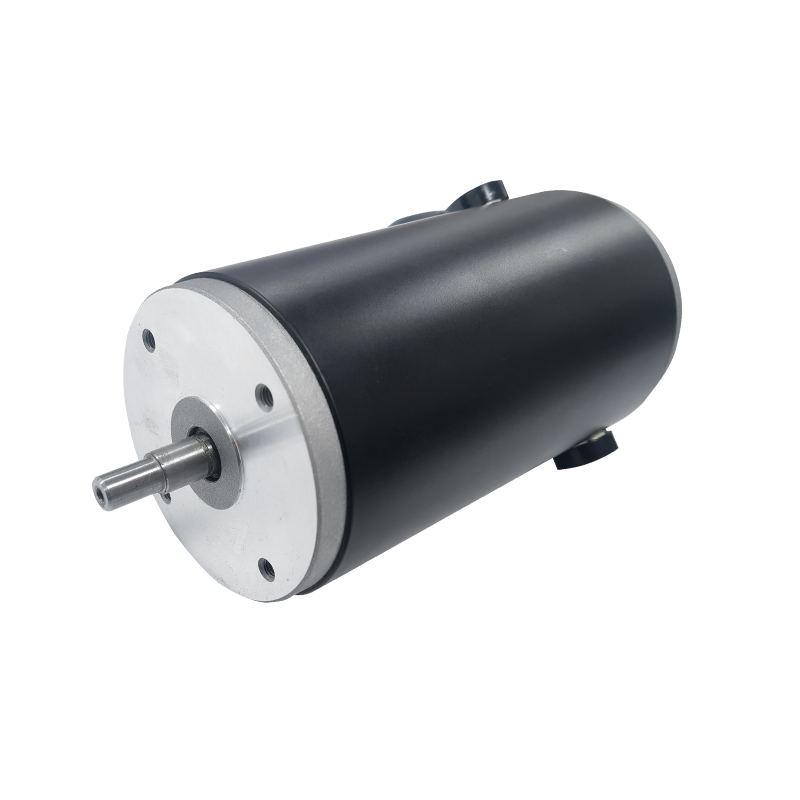
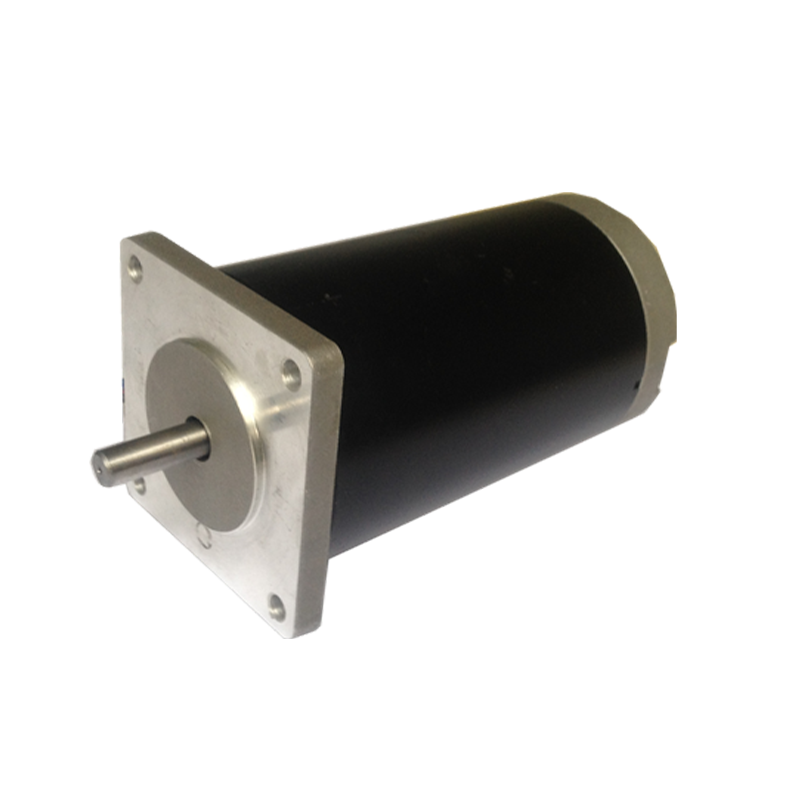
PMDC motors replace the wound field with permanent magnets, eliminating field winding copper losses and simplifying construction. They offer linear speed-torque characteristics — speed falls proportionally as torque increases — making them very predictable and easy to control. Permanent magnet motors are the dominant type in small to medium power applications: automotive auxiliary drives (window lifts, wipers, seat adjusters), power tools, printers, and small appliances. Their main limitation is that the permanent magnets can demagnetise at high temperatures or under severe overload currents.
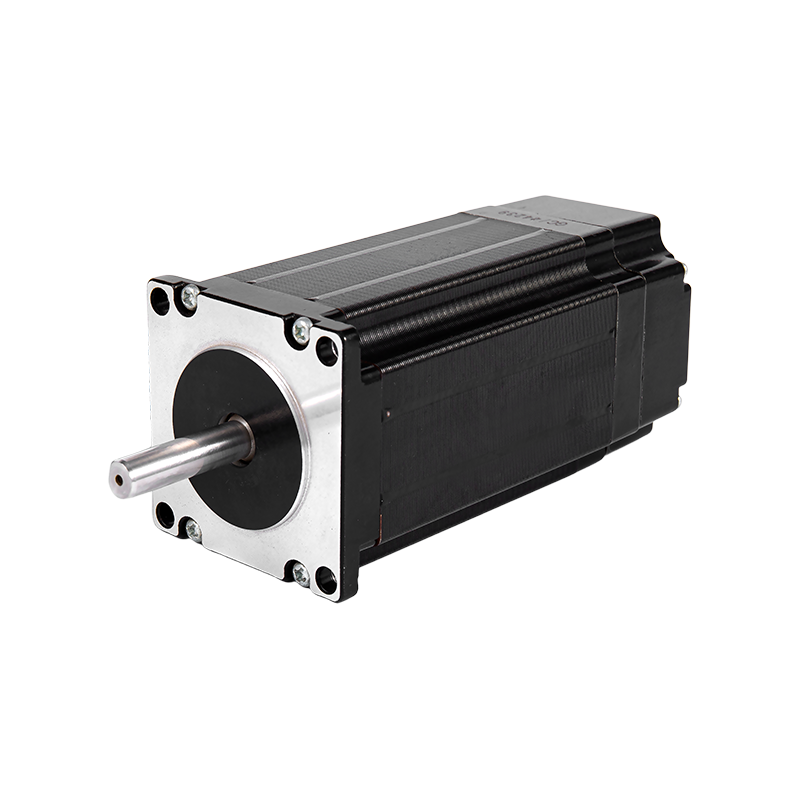
The brushless DC motor eliminates the mechanical commutator and brushes entirely. Permanent magnets are on the rotor; the stator carries the windings. An electronic controller (ESC or inverter) switches current through the stator windings in a timed sequence, producing a rotating magnetic field that the permanent magnet rotor follows. Without brushes, there is no mechanical wear at the commutation interface, giving BLDC motors dramatically longer service life, higher efficiency (typically 85–95%), lower electrical noise, and the ability to operate at much higher speeds than brushed equivalents. BLDC motors dominate electric vehicles, drones, HVAC equipment, industrial servo drives, and cordless power tools.
| Parameter | Brushed DC Motor | Brushless DC Motor |
|---|---|---|
| Commutation | Mechanical (commutator + brushes) | Electronic controller |
| Efficiency | 75–85% | 85–95% |
| Maintenance | Brush replacement required | Minimal — bearing service only |
| Cost | Lower (simpler construction) | Higher (requires controller) |
| Speed range | Limited by brush/commutator wear | Very wide — up to 100,000+ RPM |
| Electrical noise | Higher (brush arcing) | Lower |
| Control complexity | Simple (voltage control) | Requires dedicated ESC/driver |
One of the most valuable characteristics of DC motors is how straightforwardly their speed can be controlled — a property that made them the preferred choice for variable-speed industrial drives long before modern AC inverter technology existed. DC motor speed is governed by the back-EMF equation:
Speed ∝ (Supply voltage − Voltage drop across armature resistance) ÷ Magnetic flux
This equation reveals the two practical speed control methods. Armature voltage control — reducing the voltage applied to the armature — lowers speed proportionally while maintaining full field flux, preserving full torque capability at reduced speed. This is the standard method for speeds below the base (rated) speed. Field weakening — reducing the field current and therefore flux — increases speed above the base speed, but torque capacity reduces in proportion since the magnetic field is weaker. Together, these two methods give DC motors a wide controllable speed range: typically 10:1 or greater in industrial drive applications, compared to 2:1 or less for uncontrolled AC induction motors without a variable frequency drive.
In modern practice, speed control is implemented electronically. PWM (pulse-width modulation) controllers vary the effective voltage to the armature by rapidly switching the supply on and off at high frequency — the ratio of on-time to off-time (duty cycle) determines the average voltage and thus the speed. PWM control is highly efficient because the switching transistors dissipate minimal energy compared to resistive voltage-dropping methods, and it allows precise speed regulation with simple feedback from a tachometer or encoder on the motor shaft.
DC motors appear across a remarkably wide range of applications, from milliwatt-scale precision instruments to megawatt-scale industrial drives:
1. Introduction: Deconstructing AC Induction Motor Horsepower The AC Induction Motor is one of the m...
READ MORE1. Introduction In modern industrial automation, data center construction, consumer electronics upgr...
READ MOREStepper motors represent a cornerstone of modern motion control, offering precise positioning and re...
READ MOREThe industrial motor landscape is undergoing a significant transformation, driven by the relentless ...
READ MORERelated Products
Building 10, No.199, Jinfeng Road, Suzhou High-tech, Jiangsu Province, China
+86-133 3869 4967
+86-512 6876 9967
sean@retekmotion.com
rsgrivic@126.com
 WhatsApp
Copyright © Jiangsu Retek Motion Co., Ltd. All Rights Reserved. Custom OEM Industrial Multi Rotor Drone Motors Manufacturers