 Get in touch
 English
 Deutsch
 中文简体
中文简体 Español

1. Introduction: Deconstructing AC Induction Motor Horsepower The AC Induction Motor is one of the m...
READ MOREIndustry News
2026-08-18
Content
The right fpv racing drone motor directly determines how your quad handles, accelerates, and recovers from dives. Most pilots fixate on KV alone, but stator size, weight, and thrust curve matter just as much. A motor that feels sluggish on a 5-inch setup might rip perfectly on a lightweight 4-inch build. The key is matching all parameters to your flying style and typical propeller load.
A solid brushless drone motor choice starts with three numbers: the stator dimensions and the KV. After that, actual thrust data from similar builds will tell you whether the setup works. Ignore peak numbers that promise 2kg of thrust if they come with terrible efficiency — you want usable power across the throttle range, not just a spike at full punch.
FPV motor KV explained simply: KV is the theoretical RPM per volt applied, with no load. A 2700KV motor on a 4S battery (16.8V fully charged) would spin at around 45,360 RPM unloaded. Under real prop load, that drops significantly. The drone motor KV rating sets your baseline speed range, but the actual performance depends on voltage sag and prop pitch.
Racers typically run higher KV on lighter props and lower cell counts. For 5-inch racing on 4S, a 2300–2500KV motor hits the sweet spot. Move to 6S and you drop to 1700–1900KV for similar RPM. If you put a 2700KV motor on 6S with aggressive props, you'll likely smoke the windings on the first punch. Match KV to your battery voltage and intended prop size — don't just chase the highest number.
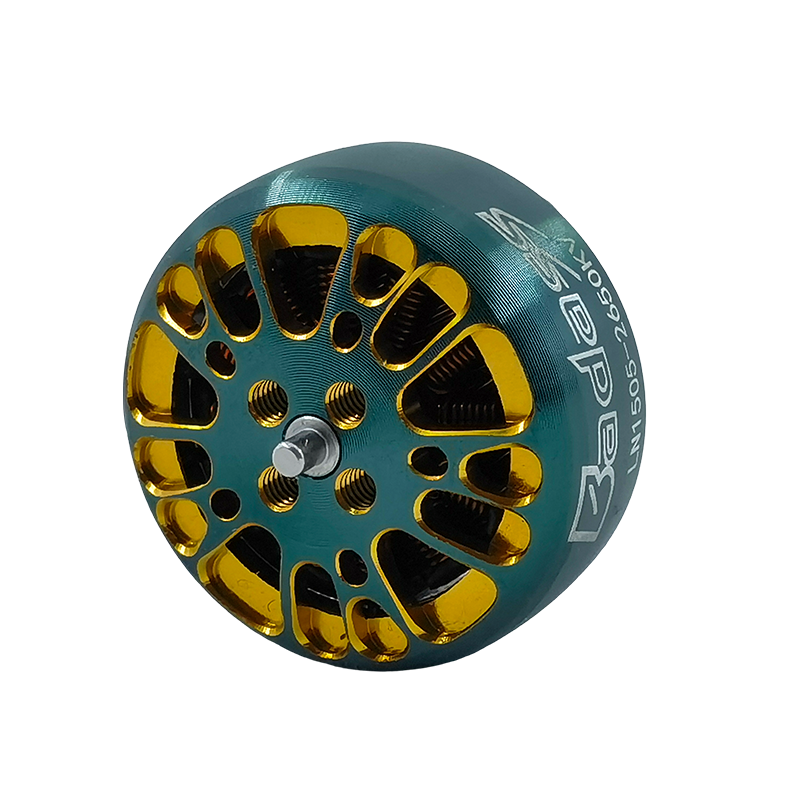
The fpv motor stator size is written as XXYY, where XX is stator width and YY is stator height, both in millimeters. A 2207 fpv motor has a 22mm wide stator and 7mm height, while a 2306 fpv motor measures 23mm wide and 6mm tall. These numbers shape torque and throttle response.
Wider stators generate more torque per amp. Taller stators add top-end power at the cost of some responsiveness. This quick drone motor size guide shows how common sizes compare:
| Stator Size | Torque Feel | Top-End Power | Best For |
|---|---|---|---|
| 2207 | Very high | Moderate | Tight tracks, quick direction changes |
| 2306 | High | Good | All-round racing and freestyle |
| 2207.5 | Very high | Moderate-high | High-grip 5-inch racing |
| 2004 | Low | Low | Ultra-light 3–4 inch builds |
For most 5-inch racing, 2207 and 2306 motors dominate because they balance torque and top-end well. Wide motors like 2408 push into heavy 6-inch territory and feel clumsy on tighter courses.
A basic drone motor thrust calculation checks whether total thrust exceeds your quad's all-up weight by at least a factor of 4. For a 700g racing drone, you need around 2800g of total thrust. That means each motor must produce at least 700g at 50–60% throttle, not just in static tests. Static thrust figures from manufacturers are measured at full throttle on a test bench — real, in-flight thrust is lower.
Modern brushless motor for racing drone setups like a 2207 1900KV on 6S with 5-inch triblades reliably deliver 1400–1600g of static thrust per motor. Four motors push well past 5kg total, giving a thrust-to-weight ratio above 7:1. That's more than enough for explosive recoveries and tight tree gaps. Use manufacturer thrust tables with your prop and voltage to verify expected numbers, but always test on your own scale — tolerances vary between batches.
When you sit down to actually choose an fpv drone motor, filter by your frame size first:
Next, pick KV based on your battery. If you run 6S, stick to the lower end of the KV range to avoid excessive current draw. A good fpv drone motor also has curved magnets (N52 or N54) and quality bearings — these details affect smoothness and crash survival more than a 50KV difference ever will. Finally, check that the motor weight doesn't push your build over the limit for the frame's intended agility.
When in doubt, start with a widely tested combination. For 5-inch racing on 6S, a 2207 1900KV or 2306 1800KV motor will give you instant grip and predictable power. If you prefer high-RPM 4S ripping, a 2306 2500KV motor pairs well with aggressive triblades. Don't overthink the fpv motor kv number — a 50KV difference won't transform your lap times, but choosing a wildly wrong KV for your voltage will absolutely end in a desync or burnt winding. Match the stator to your prop, set the KV to your battery, and spend your real practice time actually flying.
1. Introduction: Deconstructing AC Induction Motor Horsepower The AC Induction Motor is one of the m...
READ MORE1. Introduction In modern industrial automation, data center construction, consumer electronics upgr...
READ MOREStepper motors represent a cornerstone of modern motion control, offering precise positioning and re...
READ MOREThe industrial motor landscape is undergoing a significant transformation, driven by the relentless ...
READ MORERelated Products
Building 10, No.199, Jinfeng Road, Suzhou High-tech, Jiangsu Province, China
+86-133 3869 4967
+86-512 6876 9967
sean@retekmotion.com
rsgrivic@126.com
 WhatsApp
Copyright © Jiangsu Retek Motion Co., Ltd. All Rights Reserved. Custom OEM Industrial Multi Rotor Drone Motors Manufacturers