 Get in touch
 English
 Deutsch
 中文简体
中文简体 Español

1. Introduction: Deconstructing AC Induction Motor Horsepower The AC Induction Motor is one of the m...
READ MOREIndustry News
2026-04-29
Content
A DC electric motor is a machine that converts direct current electrical energy into mechanical rotational energy. When current flows through a conductor placed inside a magnetic field, a force acts on that conductor — this is the Lorentz force, and it is the physical principle behind every DC motor in existence. By arranging multiple current-carrying conductors (windings) symmetrically around a rotating shaft and managing the direction of current through them, a DC motor produces continuous, controllable rotation.
DC motors are used wherever variable-speed, high-torque, or battery-powered drive is required: power tools, electric vehicles, industrial conveyors, robotics, HVAC fans, and consumer appliances. Their defining characteristic is that rotational speed is directly proportional to the applied voltage, and torque is directly proportional to current — making them straightforward to control electronically compared to AC motors.
The two main categories of DC motor are brushed DC motors and brushless DC motors (BLDC). Both operate on the same electromagnetic principles, but they differ fundamentally in how they manage the switching of current through the motor windings — a function called commutation.
Every DC motor contains two fundamental magnetic components: the stator (the stationary outer part, which provides a fixed magnetic field) and the rotor (the rotating inner part, also called the armature). The interaction between the stator's magnetic field and the magnetic field generated by current-carrying windings on the rotor produces a rotational force — torque — that drives the shaft.
For rotation to be continuous rather than a single half-turn, the direction of current through the rotor windings must be reversed at the right moment as the rotor turns. Without this switching — called commutation — the magnetic forces would reverse and push the rotor back to its starting position. In a brushed DC motor, commutation is handled mechanically by a segmented copper ring (the commutator) mounted on the rotor shaft, and spring-loaded carbon blocks (brushes) that press against it. As the rotor turns, the brushes make sliding contact with successive commutator segments, automatically reversing the current direction at the correct point in each rotation.
A simplified brushed DC motor contains the following elements arranged around a central shaft:
The brushes and commutator are the mechanical weak points of a brushed motor. Carbon brushes wear down gradually through friction, generating heat, electrical noise, and carbon dust. At high speeds or under heavy load, brush contact can arc, causing additional wear. Most brushed motors require brush replacement after 500–2,000 operating hours depending on load and speed conditions.
A brushless DC motor (BLDC) is a DC electric motor that eliminates the commutator and brush assembly entirely, replacing mechanical commutation with electronic commutation managed by a dedicated motor controller. The result is a motor with no physical contact between stationary and rotating parts — no brushes to wear, no commutator to arc, and no carbon dust to contaminate the motor internals.
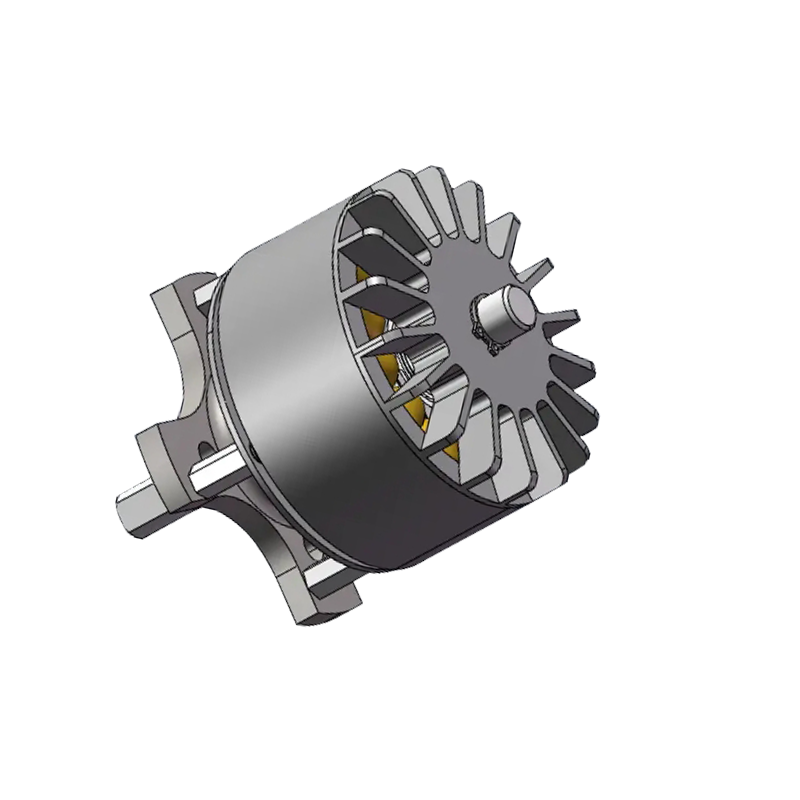
In a brushless motor, the roles of the rotor and stator are effectively inverted compared to a brushed design. The permanent magnets are mounted on the rotor, while the wound copper coils (windings) are fixed on the stator. The motor controller reads the rotor's angular position using Hall effect sensors embedded in the stator and switches current through the stator windings in the correct sequence to keep the rotor turning. This electronic switching happens thousands of times per second and is invisible to the user — but it replaces the entire mechanical commutation system of a brushed motor with solid-state electronics.
Because the windings are on the stator (the stationary part), heat generated by current flow can be dissipated directly through the motor housing — which is in contact with the surrounding air or a heatsink. In brushed motors, heat is generated inside the rotating armature, where it is harder to remove. This thermal advantage allows brushless motors to run harder for longer without overheating.
The operation of a brushless motor depends on three interacting systems: the permanent magnet rotor, the three-phase stator windings, and the electronic speed controller (ESC) or motor driver.
Brushless motors are typically built with three sets of stator windings arranged 120° apart (three-phase construction). The motor controller energizes these windings in a rotating sequence, creating a rotating magnetic field in the stator. The permanent magnet rotor chases this rotating field — always attempting to align with the nearest stator magnetic pole — and this pursuit of the rotating field is what produces continuous rotation.
The controller must know the rotor's exact position at all times to energize the correct winding at the correct moment. Hall effect sensors embedded in the stator detect the position of the rotor magnets and send position signals to the controller at every point in the rotation. Some advanced brushless motors use sensorless commutation — inferring rotor position from back-EMF (the voltage generated by the spinning rotor) rather than physical sensors — which reduces component count and improves reliability in high-speed applications.
Brushless motors routinely achieve 85–95% electrical-to-mechanical efficiency, compared to 75–85% for equivalent brushed motors. The efficiency gain comes from eliminating brush friction losses, reducing electrical resistance at the commutation points, and allowing more precise current control through electronic switching. In battery-powered applications — power tools, electric vehicles, drones — this efficiency difference translates directly into longer runtime per charge. A brushless drill running the same task as a brushed equivalent will drain its battery measurably slower, even at identical power ratings.
A brushless motor drill is a cordless drill or drill-driver powered by a brushless DC motor rather than a conventional brushed motor. Brushless drills first appeared in professional-grade tools around 2009–2012 and have since become the standard across all performance tiers from DIY to industrial use.
The practical advantages of brushless motor drills over brushed equivalents are substantial and directly traceable to the motor design differences described above:
The primary trade-off is cost: the electronic speed controller adds manufacturing complexity, making brushless drills more expensive than brushed equivalents at equivalent power levels. However, the price premium has fallen sharply as production volumes have scaled — entry-level brushless drills are now available at prices that were previously only achievable with brushed motors, making the brushless advantage accessible across all budgets.
For occasional light use — hanging pictures, assembling flat-pack furniture — a brushed drill is adequate and cost-effective. The efficiency and longevity advantages of brushless motors are most valuable in high-duty-cycle applications: tradespeople using their drill for multiple hours daily, applications requiring maximum runtime on a single charge, or tasks demanding consistent torque over long periods such as driving large numbers of screws or boring through dense timber and masonry. For any cordless drill that will see regular professional or semi-professional use, brushless is the correct choice.
| Parameter | Brushed DC Motor | Brushless DC Motor |
|---|---|---|
| Commutation method | Mechanical (brushes + commutator) | Electronic (motor controller + Hall sensors) |
| Magnets location | Stator (fixed) | Rotor (rotating) |
| Windings location | Rotor (rotating) | Stator (fixed) |
| Typical efficiency | 75–85% | 85–95% |
| Heat dissipation | Poor (heat trapped in rotor) | Good (heat at stator, near housing) |
| Maintenance | Brush replacement required | Essentially maintenance-free |
| Noise and EMI | Higher (brush arcing) | Lower |
| Controller complexity | Simple (direct voltage control) | Higher (requires ESC/driver) |
| Unit cost | Lower | Higher |
| Lifespan | Limited by brush wear | Limited by bearings, not motor |
Brushless DC motors now dominate applications where efficiency, longevity, or precise electronic control are priorities. Brushed motors remain in production for cost-sensitive, low-duty-cycle, or simplicity-critical applications where their lower unit cost and simpler drive circuits outweigh their performance disadvantages. In the power tool segment specifically, the market has shifted decisively toward brushless — most major tool manufacturers now offer brushless variants across their entire cordless ranges, from compact screwdrivers to heavy-duty hammer drills and angle grinders.
1. Introduction: Deconstructing AC Induction Motor Horsepower The AC Induction Motor is one of the m...
READ MORE1. Introduction In modern industrial automation, data center construction, consumer electronics upgr...
READ MOREStepper motors represent a cornerstone of modern motion control, offering precise positioning and re...
READ MOREThe industrial motor landscape is undergoing a significant transformation, driven by the relentless ...
READ MORERelated Products
Building 10, No.199, Jinfeng Road, Suzhou High-tech, Jiangsu Province, China
+86-133 3869 4967
+86-512 6876 9967
sean@retekmotion.com
rsgrivic@126.com
 WhatsApp
Copyright © Jiangsu Retek Motion Co., Ltd. All Rights Reserved. Custom OEM Industrial Multi Rotor Drone Motors Manufacturers